

Assessment of forced spirometry quality in healthy adults at 2,700 meters above sea level
Abstract
Introduction. Forced spirometry evaluates respiratory mechanics according to the 2019 American Thoracic Society and European Respiratory Society criteria. The quality of the test depends on the evaluation of the curves obtained according to acceptability and repeatability, in addition to environmental factors such as altitude above sea level.
Objective. To determine the quality of forced spirometry tests in a healthy adult population at 2,700 meters above sea level.
Materials and methods. We conducted a prospective quantitative cohort study on reference values for forced spirometry in a healthy population at 2,700 meters above sea level. Test quality was evaluated using acceptability and repeatability criteria. Based on a prospective quantitative cohort study of forced spirometry reference values in a healthy respiratory population at 2,700 meters above sea level, the quality of the tests was evaluated considering the acceptability and repeatability criteria.
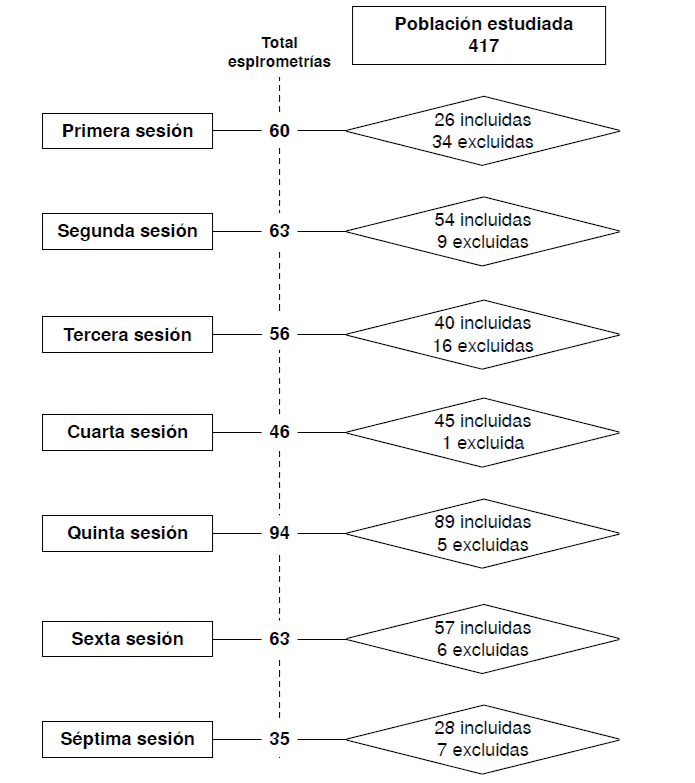
Results. We performed 417 forced spirometry tests in a healthy adult population at 2,700 meters above sea level, 81% of which fulfilled the quality criteria. A greater proportion of tests did not meet the acceptability criteria, specifically, “the good start” item due to a time higher than 150 ms to achieve the peak expiratory flow; followed by artifacts such as glottic closure, the most frequent; and “the good end” criterion due to an early termination of
exhalation.
Conclusions. As the sessions progressed, the quality of the forced spirometry tests was optimized, a condition favored by the improvement of the technique and continuous training of the professionals.
Downloads
References
Rivero-Yeverino D. Espirometría: conceptos básicos. Rev Alerg Méx. 2019;66:76-84. https://doi.org/10.29262/ram.v66i1.536
Benítez-Pérez RE, Cortés-Telles A, Meneses-Tamayo E, Silva-Cerón M, Río-Hidalgo RF, Monraz-Pérez S, et al. Espirometría: actualización del procedimiento y perspectivas pospandemia. Neumol Cir Torax. 2023;82:104-24. https://doi.org/10.35366/115397
Graham BL, Steenbruggen I, Miller MR, Barjaktarevic IZ, Cooper BG, Hall GL, et al. Standardization of spirometry 2019 update: An official American Thoracic Society and European Respiratory Society Technical statement. Am J Respir Crit Care Med. 2019;200:e70-88. https://doi.org/10.1164/rccm.201908-1590ST
Benítez-Pérez RE, Torres-Bouscoulet L, Villca-Alá N, Del-Río-Hidalgo RF, Pérez-Padilla R, Vásquez-García JC, et al. Espirometría: recomendaciones y procedimiento. Neumol Cir Torax. 2019;78(Supl. 2):S97-112. https://doi.org/10.35366/NTS192C
Rojas MX, Dennis RJ. Valores de referencia para parámetros de espirometría en la población adulta residente en Bogotá, D. C., Colombia. Biomédica. 2010;30:82-94. https://doi.org/10.7705/biomedica.v30i1.156
Luks AM, McIntosh SE, Grissom CK, Auerbach PS, Rodway GW, Schoene RB, et al. Wilderness Medical Society practice guidelines for the prevention and treatment of acute altitude illness: 2014 update. Wilderness Environ Med. 2014;25(Supl. 4):S4-14. https://doi.org/10.1016/j.wem.2014.06.017
Reeves JT, Weil JV. Aclimatación ventilatoria a grandes altitudes. En: Dümmer W, editor. Enciclopedia de salud y seguridad en el trabajo. Presión barométrica, reducción. Cuarta edición. Madrid: Instituto Sindical de Trabajo, Ambiente y Salud (ISTAS); 2000. p. 37.
Quemba-Mesa MP, Valero-Ortiz AS, Roa-Cubaque MA, Umbacía-Salas FA, Wilches MR, Pirachicán LC. Valores de referencia de espirometría forzada de adultos residentes sobre o bajo 1.500 m s. n. m.: revisión sistemática. Rev Univ Ind Santander Salud. 2023;55:23034. https://doi.org/10.18273/saluduis.55.e23034
Vargas López AM, Gaviria Higuera JN, Robles Arciniegas KD, Manrique Abril FG, Herrera Amaya GM. La espirometría en atención primaria en salud. Salud Sociedad UPTC (en línea). 2024;9:85-107. https://doi.org/10.19053/uptc.2744953X.18385
San Martín V. Evaluación de la aceptabilidad, reproductividad y calidad de las espirometrías realizadas en un servicio neumológico de adultos. An Fac Cienc Méd Asunción. 2018;51:29-36. https://doi.org/10.18004/anales/2018.051(01)29-036
Schönffeldt GP, Álvarez GC, Avello FR, Beroíza WT, Caviedes SI, Céspedes GJ, et al. Espirometría: manual de procedimientos. SER Chile, actualización 2024. Rev Chil Enferm Respir. 2024;40:93-109. https://doi.org/10.4067/s0717-73482024000200093
Rodríguez Rocha C, Rodríguez Álvarez C, Ramos de Armas M, Ruiznavarro Menéndez C, Anta Agudo B, Arias Rodríguez A. Calidad de las espirometrías en atención primaria de Tenerife. Rev Esp Patol Torac. 2014;26:262-7.
Alavi Foumani A, Alavi Foumani SA, Attarchi M, Etemadi Deilami A, Majlesi B, Ildari S, et al. Quality of spirometry tests in the field of occupational health. BMC Res Notes. 2024;17:11. https://doi.org/10.1186/s13104-023-06671-x
San Martín V. Evaluación de la aceptabilidad, reproductividad y calidad de las espirometrías realizadas en un servicio neumológico de adultos. An Fac Cienc Méd. 2018;51:29-36. https://doi.org/10.18004/anales/2018.051(01)29-036
Enright P, Vollmer WM, Lamprecht B, Jensen R, Jithoo A, Tan W, et al. Quality of spirometry tests performed by 9893 adults in 14 countries: The BOLD Study. Respir Med. 2011;105:1507-15. https://doi.org/10.1016/j.rmed.2011.04.008
Araya BM, Pertuzé RJ, Valdivia CG, Batista MAM, Pérez PR, Fuentes YH, et al. Calidad de las espirometrías en un estudio epidemiológico de terreno: factores determinantes de la necesidad de repetir el examen en el estudio Platino-Chile. Rev Chil Enf Respir. 2005;21:155-63. https://doi.org/10.4067/S0717-73482005000300002
van de Hei SJ, Flokstra-de Blok BMJ, Baretta HJ, Doornewaard NE, van der Molen T, Patberg KW, et al. Quality of spirometry and related diagnosis in primary care with a focus on clinical use. NPJ Prim Care Respir Med. 2020;30:22. https://doi.org/10.1038/s41533-020-0177-z
Some similar items:
- María Ximena Rojas, Rodolfo José Dennis, Reference values for respiratory parameters in the adult population of Bogotá, D.C., Colombia , Biomedica: Vol. 30 No. 1 (2010)
- Constanza Collazos, Gabriel Carrasquilla, Milcíades Ibáñez, Lilia Edith López, Prevalence of respiratory symptomatic in health institutions of Bogotá, Colombia , Biomedica: Vol. 30 No. 4 (2010)
- Astrid Berena Herrera, Laura A. Rodríguez, Jürg Niederbacher, Biological pollution and its relationship with respiratory symptoms indicative of asthma, Bucaramanga, Colombia , Biomedica: Vol. 31 No. 3 (2011)
- Jorge H. Botero, Martha Nelly Montoya, Adriana Lucía Vanegas, Abel Díaz, Luis Navarro-i-Martínez, Fernando Jorge Bornay, Fernando Izquierdo, Carmen del Aguila, Sonia del Pilar Agudelo, Frequency of intestinal microsporidian infections in HIV-positive patients, as diagnosis by quick hot Gram chromotrope staining and PCR. , Biomedica: Vol. 24 No. 4 (2004)
- Eliseo Bustamante, Álvaro Sanabria, Spanish adaptation of The Penn State College of Medicine Scale to assess professionalism in medical students , Biomedica: Vol. 34 No. 2 (2014)
- Omar Segura, Burnout: concepts and implications affecting public health , Biomedica: Vol. 34 No. 4 (2014)
- Freddy Ruiz-López, Ana González-Mazo, Andrés Vélez-Mira, Giovan F. Gómez, Luisa Zuleta, Sandra Uribe, Iván Darío Vélez-Bernal, Presence of Aedes (Stegomyia) aegypti (Linnaeus, 1762) and its natural infection with dengue virus at unrecorded heights in Colombia , Biomedica: Vol. 36 No. 2 (2016)
- Mónica María Lopera, Commented review of the Colombian legislation regarding the ethics of health research , Biomedica: Vol. 37 No. 4 (2017)
- Nubia González, Sara Lucía Díaz, Myriam Rocío Wilches, Mabel Patricia Franky, Cesar Méndez A, Andrea del Rosario Herrera, Spirometry in a population of coal miners in Paipa, Colombia , Biomedica: Vol. 37 No. 4 (2017)
- Jorge Mario Estrada-Alvarez, Juan Pablo Orozco-Hernández, Dr. Aristizabal-Franco, Validation of chronic obstructive pulmonary disease severity score (COPDSS) for primary care in a Colombian population , Biomedica: Vol. 40 No. 4 (2020)
Copyright (c) 2025 Biomedica

This work is licensed under a Creative Commons Attribution 4.0 International License.
| Article metrics | |
|---|---|
| Abstract views | |
| Galley vies | |
| PDF Views | |
| HTML views | |
| Other views | |