

Update of the spatiotemporal distribution of Aedes albopictus in Ecuador
Abstract
Introduction. Aedes albopictus has spread to 85 countries due to its ability to adapt to new climatic conditions. In Ecuador, it was first identified in Guayaquil in 2017 and since then it has expanded into new geographical areas. Its importance for public health has been linked to its vector capacity to transmit arboviruses.
Objective. To characterize Ae. albopictus breeding sites that have contributed to its dispersal into geographical regions of Ecuador without prior records.
Materials and methods. Entomological sampling was conducted in 18 provinces between 2018 and 2024. We collected larvae from various types of water-holding containers. We generated spatiotemporal distribution maps of Ae. albopictus and performed statistical analyses to identify significant differences in the number of mosquitoes between different breeding sites.
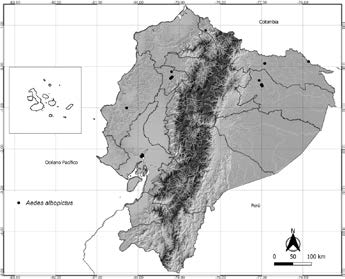
Results. Between 2018 and 2024, the presence of Ae. albopictus was recorded in 311 localities in the provinces of Manabí, Guayas, Santo Domingo de los Tsáchilas, Orellana, Imbabura, and Sucumbíos. Cans, tires, and plastic tanks were identified as effective breeding sites, while natural containers, such as bamboo internodes, puddles, and bromelia axils, were less frequent. Spearman’s correlation showed a significant positive relationship (p value < 5.0 × 10⁻⁴) between the frequency of breeding sites and the number of individuals.
Conclusions. Entomological surveillance activities contributed to establish Ae. albopictus distribution in urban areas of six provinces in Ecuador. A positive correlation was identified between the number of mosquitoes and the frequency of breeding sites, such as tires, tanks, and other water-holding plastic containers.
Downloads
References
1. Cunze S, Kochmann J, Koch LK, Klimpel S. Aedes albopictus and its environmental limits in Europe. PLoS ONE. 2016;11:0162116. https://doi.org/10.1371/journal.pone.0162116
2. Ortiz-Canamejoy K, Villota AC. Primera evidencia de Aedes albopictus en el departamento del Putumayo, Colombia. MedUNAB. 2018;21:10-5. https://doi.org/10.29375/01237047.3416
3. Lambrechts L, Scott TW, Gubler DJ. Consequences of the expanding global distribution of Aedes albopictus for dengue virus transmission. PLoS Negl Trop Dis. 2010;4:646. https://doi.org/10.1371/journal.pntd.0000646
4. Venturi G, Di Luca M, Fortuna C, Remoli ME, Riccardo F, Severini F, et al. Detection of a chikungunya outbreak in Central Italy, August to September 2017. Euro Surveill. 2017;22:17-00646. https://doi.org/10.2807/1560-7917.ES.2017.22.39.17-00646
5. Grard G, Caron M, Mombo IM, Nkoghe D, Mboui Ondo S, Jiolle D, et al. Zika virus in Gabon (Central Africa) – 2007: A new threat from Aedes albopictus. PLoS Negl Trop Dis. 2014;8:2681. https://doi.org/10.1371/JOURNAL.PNTD.0002681
6. Pereira-Dos-Santos T, Roiz D, Lourenço-De-Oliveira R, Paupy C. A systematic review: Is Aedes albopictus an efficient bridge vector for zoonotic arboviruses. Pathogens?. 2020;9:266. https://doi.org/10.3390/pathogens9040266
7. Gratz NG. Critical review of the vector status of Aedes albopictus. Med Vet Entomol. 2004;18:215-27. https://doi.org/10.1111/J.0269-283X.2004.00513.X
8. Wilkerson RC, Linton Y-M, Strickman D. Mosquitoes of the World. Baltimore: Johns Hopkins University Press; 2021. p. 162-80. https://doi.org/10.1353/book.79680
9. Miller MJ, Loaiza JR. Geographic expansion of the invasive mosquito Aedes albopictus across Panama—Implications for control of dengue and Chikungunya viruses. PLoS Negl Trop Dis. 2015;9:3383. https://doi.org/10.1371/journal.pntd.0003383
10. García-Rejon JE, Navarro J-C, Cigarroa-Toledo N, Baak-Baak CM. An updated review of the invasive Aedes Albopictus in the Americas; Geographical distribution, host feeding patterns, arbovirus infection, and the potential for vertical transmission of dengue virus. Preprints.org [Preprint]. 2021. https://doi.org/10.20944/preprints202107.0339.v2
11. Ogden NH, Milka R, Caminade C, Gachon P. Recent and projected future climatic suitability of North America for the Asian tiger mosquito Aedes albopictus. Parasit Vectors. 2014;7:1-14. https://doi.org/10.1186/s13071-014-0532-4/figures/6
12. Roiz D, Neteler M, Castellani C, Arnoldi D, Rizzoli A. Climatic factors driving invasion of the tiger mosquito (Aedes albopictus) into new areas of Trentino, Northern Italy. PLoS ONE. 2011;6:e14800. https://doi.org/10.1371/journal.pone.0014800
13. Canelas T, Thomsen E, Kamgang B, Kelly-Hope LA. Demographic and environmental factors associated with the distribution of Aedes albopictus in Cameroon. Med Vet Entomol. 2023;37:143-51. https://doi.org/10.1111/MVE.12619
14. Ponce P, Morales Di, Argoti A, Cevallos VE. First report of Aedes (Stegomyia) albopictus (Skuse) (Diptera: Culicidae), the Asian tiger mosquito, in Ecuador. J Med Entomol. 2018;55:248-9. https://doi.org/10.1093/JME/TJX165
15. Carrazco-Montalvo A, Ponce P, Villota SD, Quentin E, Muñoz-Tobar S, Coloma J, et al. Establishment, genetic diversity, and habitat suitability of Aedes albopictus populations from Ecuador. Insects. 2022;13:305.
16. Lührsen DS, Zavitsanou E, Cerecedo-Iglesias C, Pardo-Araujo M, Palmer JRB, Bartumeus F, et al. Adult Aedes albopictus in winter: Implications for mosquito surveillance in southern Europe. Lancet Planet Health 2023;7:e729–31. https://doi.org/10.1016/S2542-5196(23)00170-5
17. Calle-Tobón A, Pérez-Pérez J, Rojo R, Rojas-Montoya W, Triana-Chávez O, Rúa-Uribe G, et al. Surveillance of Zika virus in field-caught Aedes aegypti and Aedes albopictus suggests important role of male mosquitoes in viral populations maintenance in Medellín, Colombia. Infect Genet Evol. 2020;85:104434. https://doi.org/10.1016/j.meegid.2020.104434
18. Ministerio del Ambiente del Ecuador. Sistema de clasificación de ecosistemas de Ecuador Continental. Primera edición. Quito: Ministerio del Ambiente; 2013. p. 235.
19. Ministerio de Salud Pública del Ecuador. Vigilancia y control de vectores en el Ecuador, Norma técnica. Quito: Ministerio de Salud Pública; 2019. p. 111.
20. Rueda LM. Pictorial keys for the identification of mosquitoes (Diptera: Culicidae) associated with dengue virus transmission. Zootaxa. 2004;589:1-60. https://doi.org/10.11646/zootaxa.589.1.1
21. Reinhold JM, Lazzari CR, Lahondère C. Effects of the environmental temperature on Aedes aegypti and Aedes albopictus mosquitoes: A review. Insects. 2018;9:158. https://doi.org/10.3390/insects9040158
22. Neto PL, Navarro-Silva MA. Development, longevity, gonotrophic cycle, and oviposition of Aedes albopictus Skuse (Diptera: Culicidae) under cyclic temperatures. Neotrop Entomol. 2004;33:29-33. https://doi.org/10.1590/S1519-566X2004000100006
23. Neteler M, Roiz D, Rocchini D, Castellani C, Rizzoli A. Terra and Aqua satellites track tiger mosquito invasion: Modelling the potential distribution of Aedes albopictus in North-Eastern Italy. Int J Health Geogr. 2011;10:1-14. https://doi.org/10.1186/1476-072x-10-49/figures/7
24. Echeverry-Cárdenas E, López-Castañeda C, Carvajal-Castro JD, Aguirre-Obando OA. Potential geographic distribution of the tiger mosquito Aedes albopictus (Skuse, 1894) (Diptera: Culicidae) in current and future conditions for Colombia. PLoS Negl Trop Dis. 2021;15:e0008212. https://doi.org/10.1371/journal.pntd.0008212
25. Mejía-Jurado E, Echeverry-Cárdenas E, Aguirre-Obando OA. Potential current and future distribution for Aedes aegypti and Aedes albopictus in Colombia: Important disease vectors. Biol Invasions. 2024 26:2119-37. https://doi.org/10.1007/S10530-024-03298-2
26. Soares APM, Rosário ING, Silva IM. Distribution and preference for oviposition sites of Aedes albopictus (Skuse) in the metropolitan area of Belém, in the Brazilian Amazon. J Vector Ecol. 2020;45:312-20. https://doi.org/10.1111/jvec.12402
27. Ayllón T, Câmara DCP, Morone FC, da Silva Gonçalves L, de Barros FSM, Brasil P, et al. Dispersion and oviposition of Aedes albopictus in a Brazilian slum: Initial evidence of Asian tiger mosquito domiciliation in urban environments. PLoS ONE. 2018;13:0195014. https://doi.org/10.1371/journal.pone.0195014
28. Cuenca MA. Extractivism in the amazon region. In: Resource extraction and urbanism in Ecuador. Venice: Università Iuav di Venezia; 2023. p. 324. https://dx.doi.org/10.25432/cuenca-rosillo-maria-de-los-ngeles_phd2023-03-03
29. Carvalho RG, Lourenço-De-Oliveira R, Braga IA. Updating the geographical distribution and frequency of Aedes albopictus in Brazil with remarks regarding its range in the Americas. Mem Inst Oswaldo Cruz. 2014;109:787-96. https://doi.org/10.1590/0074-0276140304
30. Bennett KL, Gómez Martínez C, Almanza A, Rovira JR, McMillan WO, Enriquez V, et al. High infestation of invasive Aedes mosquitoes in used tires along the local transport network of Panama. Parasit Vectors. 2019;12:1-10. https://doi.org/10.1186/S13071-019-3522-8/figures/2
31. Eritja R, Palmer JRB, Roiz D, Sanpera-Calbet I, Bartumeus F. Direct evidence of adult Aedes albopictus dispersal by car. Sci Rep. 2017;7:1-15. https://doi.org/10.1038/s41598-017-12652-5
32. Valencia-Marín BS, Gandica ID, Aguirre-Obando OA. The Mayaro virus and its potential epidemiological consequences in Colombia: An exploratory biomathematics analysis. Parasit Vectors. 2020;13:1-16. https://doi.org/10.1186/S13071-020-04354-1/FIGURES/7
33. Alarcón-Elbal PM, López-De-Felipe M, Gil-Torró I, García-Masiá I, Mateo-Herrero P, Bueno-Marí R. Where does Aedes albopictus (Diptera: Culicidae) really breed in a Mediterranean residential area? Results from a field study in Valencia, Eastern Spain. Bull Entomol Res. 2024;114:383-92. https://doi.org/10.1017/S0007485324000191
34. Li CF, Lim TW, Han LL, Fang R. Rainfall, abundance of Aedes aegypti and dengue infection in Selangor, Malaysia. Southeast Asian J Trop Med Public Health. 1985;16:560-8.
35. Dieng H, Saifur RGM, Hassan AA, Che Salmah MR, Boots M, Satho T, et al. Indoorbreeding of Aedes albopictus in Northern Peninsular Malaysia and its potential epidemiological implications. PLoS ONE. 2010;5:e11790. https://doi.org/10.1371/journal.pone.0011790
36. Serpa LLN, Monteiro Marques GRA, De Lima AP, Voltolini JC, Arduino MDB, Barbosa GL, et al. Study of the distribution and abundance of the eggs of Aedes aegypti and Aedes albopictus according to the habitat and meteorological variables, municipality of São Sebastião, São Paulo State, Brazil. Parasit Vectors. 2013;6:1-11. https://doi.org/10.1186/1756-3305-6-321/figures/4
37. Susong KM, Tucker BJ, Bron GM, Irwin P, Kirsch JM, Vimont D, et al. Snow-covered tires generate microhabitats that enhance overwintering survival of Aedes albopictus (Diptera: Culicidae) in the Midwest, USA. Environ Entomol 2022;51:586-94. https://doi.org/10.1093/ee/nvac023
38. Herath JMMK, De Silva WAPP, Weeraratne TC, Karunaratne SHPP. Breeding hábitat preference of the dengue vector mosquitoes Aedes aegypti and Aedes albopictus from urban, semiurban, and rural areas in Kurunegala District, Sri Lanka. J Trop Med. 2024;2024:4123543. https://doi.org/10.1155/2024/4123543
39. Kraemer MUG, Reiner RC, Brady OJ, Messina JP, Gilbert M, Pigott DM, et al. Past and future spread of the arbovirus vectors Aedes aegypti and Aedes albopictus. Nat Microbiol. 2019 4:854-63. https://doi.org/10.1038/s41564-019-0376-y
Some similar items:
- Celeny Ortiz, Guillermo L. Rúa-Uribe, Carlos A. Rojas, Knowledge, practices and entomological aspects of dengue in Medellín, Colombia: A comparative study of neighborhoods with high and low incidence , Biomedica: Vol. 38 No. Sup. 2 (2018): Suplemento 2, Medicina tropical
- Carlos Sermeño-Correa, Alexander Bedoya-Polo, Erwin Camacho, Eduar Bejarano-Martínez, Sticky traps for Aedes aegypti surveillance and targeted vector control in Sincelejo, Colombia , Biomedica: Vol. 45 No. 1 (2025)
- Raúl A. Rojo-Ospina, Marcela Quimbayo-Forero, Arley Calle-Tobón, Sindy C. Bedoya-Patiño, Maribel Gómez, Astrid Ramírez, Johnny Sánchez, Juan F. Silva-Alzate, Carlos J. Montes-Zuluaga, Jorge M. Cadavid, Enrique A. Henao-Correa, Integrated vector management program in the framework of the COVID-19 pandemic in Medellin, Colombia , Biomedica: Vol. 43 No. 1 (2023)
- Mikel A. González , María Altagracia Rodríguez-Sosa , Yohan Enmanuel Vásquez-Bautista , Elizabeth del Carmen Rosario , Jesús Confesor Durán-Tiburcio , Pedro María Alarcón-Elbal, A survey of tire-breeding mosquitoes (Diptera: Culicidae) in the Dominican Republic: Considerations about a pressing issue , Biomedica: Vol. 40 No. 3 (2020)
- Jorge R. Rey, Philip Lounibos, Ecology of Aedes aegypti and Aedes albopictus in the Americas and disease transmission , Biomedica: Vol. 35 No. 2 (2015)
- Cristian Camilo Canizales, Julio Cesar Carranza , Gustavo Adolfo Vallejo, Daniel Alfonso Urrea , Aedes albopictus distribution in Ibagué, Colombia: Potential risk of arboviral outbreaks , Biomedica: Vol. 43 No. 4 (2023)
- Eliana Patricia Calvo , Edwin Darío Archila, Lady López, Jaime Eduardo Castellanos, Rediscovering the chikungunya virus , Biomedica: Vol. 41 No. 2 (2021)
- Gabriel Parra-Henao, Laura Suárez, Mosquitoes (Diptera: Culiciadae) as potential vectors of arbovirused in the Urabá region, Northwest of Colombia , Biomedica: Vol. 32 No. 2 (2012)
- Manuel Muñoz, Juan Carlos Navarro, Mayaro: A re-emerging Arbovirus in Venezuela and Latin America , Biomedica: Vol. 32 No. 2 (2012)
- Paola Andrea Rueda , Sara Orozco , Juan Raúl Castro , Ángela María Londoño, Elsa María Vásquez, Andrea Arango, Carlos Esteban Builes , Incidence and prevalence of vitiligo by gender and age in the Colombian population , Biomedica: Vol. 45 No. 4 (2025)
Copyright (c) 2025 Biomedica

This work is licensed under a Creative Commons Attribution 4.0 International License.
| Article metrics | |
|---|---|
| Abstract views | |
| Galley vies | |
| PDF Views | |
| HTML views | |
| Other views | |