
Brotes e incidencia de enfermedades transmitidas por vectores en Colombia (2007- 2024): impacto del cambio climático y la deforestación
Resumen
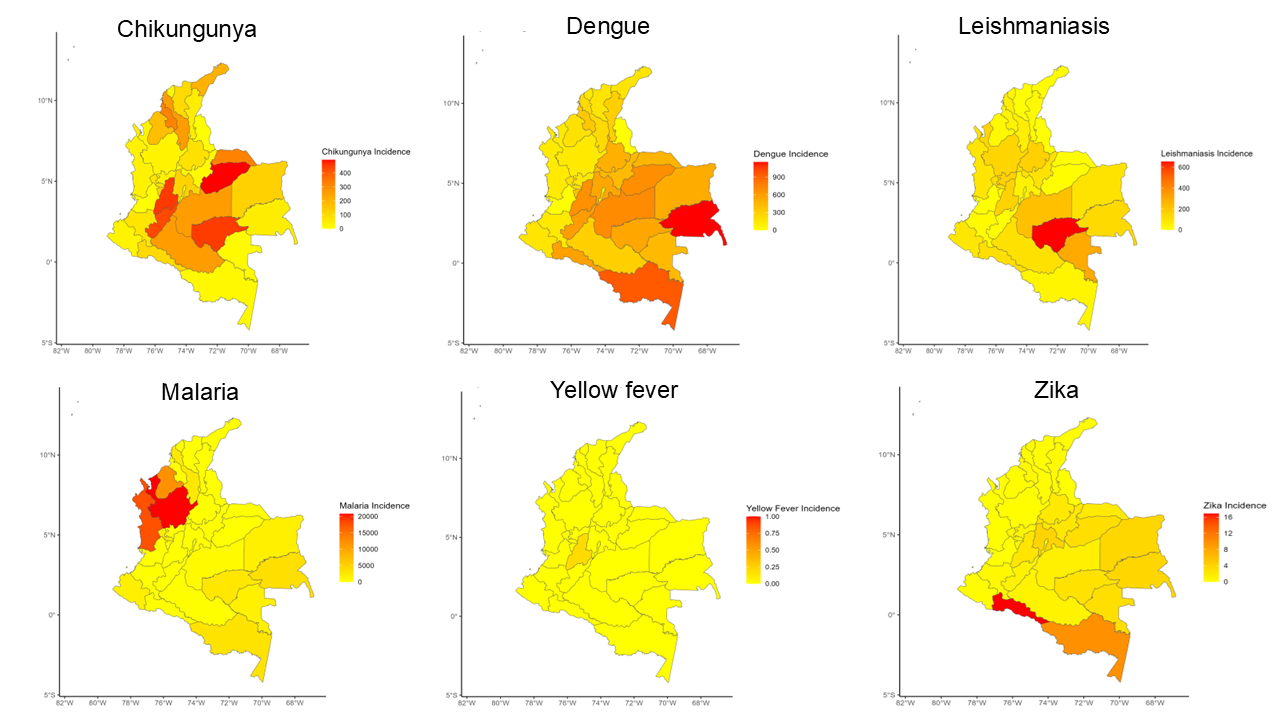
Introducción. Las enfermedades transmitidas por vectores representan un desafío para la salud pública en Colombia, influenciadas por factores climáticos y ambientales. El Niño y la deforestación pueden alterar los hábitats de los vectores, afectando la incidencia de dengue, fiebre de chikunguña, enfermedad por el virus del Zika, malaria, leishmaniasis cutánea y fiebre amarilla.
Objetivo. Analizar la relación entre estas variables y la incidencia de las enfermedades transmitidas por vectores en Colombia (2007-2024).
Materiales y métodos. Se realizó un estudio ecológico utilizando los datos de incidencia y brotes de seis enfermedades transmitidas por vectores, vinculados con información climática, El Niño y deforestación. Se aplicaron modelos de regresión y bosques aleatorios para evaluar asociaciones.
Resultados. Entre el 2007 y el 2024, se registraron en Colombia 3´283.259 casos de enfermedades transmitidas por vectores. De estos, el 49,9 % (1’639.120) correspondieron a dengue y el 39,8 % (1’307.351) a malaria, representando el 89,7 % del total. El Niño se asoció con un aumento en la incidencia de dengue (β = 213,24; IC 95%: 86.05-338.43), fiebre de chikunguña (β = 26,41; IC 95%: 17,54-70,36) y enfermedad por el virus del Zika (β = 14,12; IC 95%: 10,06-89,30). La temperatura máxima mostró una relación positiva con el dengue (β = 5,74; IC 95%: 2,15-13,63) y la malaria (β = 17,28; IC 95%: 3,81-30,75). La deforestación se asoció con malaria (β = 12,35; IC 95%: 4,62-20,08) y leishmaniasis (β =8,67; IC 95%: 2,21-15,13). La precipitación media tuvo asociaciones negativas con fiebre de chikunguña y leishmaniasis.
Conclusiones. El cambio climático y la deforestación impactan la epidemiología de las enfermedades transmitidas por vectores en Colombia. Se requieren estrategias integradas de salud pública y conservación ambiental para mitigar sus efectos.
Descargas
Referencias bibliográficas
Molina-Guzmán LP, Gutiérrez-Builes LA, Ríos-Osorio LA. Models of spatial analysis for vector-borne diseases studies: A systematic review. Vet World. 2022;15:1975-89. https://doi.org/10.14202/vetworld.2022.1975-1989
El-Sayed A, Kamel M. Climatic changes and their role in emergence and re-emergence of diseases. Environ Sci Pollut Res Int. 2020;27:22336-52. https://doi.org/10.1007/s11356-020-08896-w
Yadav N, Upadhyay RK. Global effect of climate change on seasonal cycles, vector population and rising challenges of communicable diseases: A review. J Atmospheric Sci Res. 2023;6:21-59. https://doi.org/10.30564/jasr.v6i1.5165
Cai W, Santoso A, Collins M, Dewitte B, Karamperidou C, Kug J-S, et al. Changing El Niño- Southern oscillation in a warming climate. Nat Rev Earth Environ. 2021;2:628-44. https://doi.org/10.1038/s43017-021-00199-z
Chretien J-P, Anyamba A, Small J, Britch S, Sánchez JL, Halbach AC, et al. Global climate anomalies and potential infectious disease risks: 2014-2015. PLoS Curr. 2015;26:7. https://doi.org/10.1371/currents.outbreaks.95fbc4a8fb4695e049baabfc2fc8289f
Ortiz DI, Piche-Ovares M, Romero-Vega LM, Wagman J, Troyo A. The impact of deforestation, urbanization, and changing land use patterns on the ecology of mosquito and tick-borne diseases in Central America. Insects. 2021;13:20. https://doi.org/10.3390/insects13010020
Segura NA, Muñoz AL, Losada-Barragán M, Torres O, Rodríguez AK, Rangel H, et al. Minireview: Epidemiological impact of arboviral diseases in Latin American countries, arbovirus-vector interactions and control strategies. Pathog Dis. 2021;79:ftab043. https://doi.org/10.1093/femspd/ftab043
Khan A, Yasin M, Aqueel MA, Farooqi MA, Akram MI, Yousuf HMB, et al. Vector-borne disease and climate change. In: Shields VDC, editor. Arthropods-new advances and perspectives. IntechOpen; 2023. https://doi.org/10.5772/intechopen.107120
Padilla-Rodríguez JC, Olivera MJ, Padilla MC, Abril EP. Malaria epidemics in Colombia, 1970-2019. Rev Soc Bras Med Trop. 202229:55:e05592021. https://doi.org/10.1590/0037-8682-0559-2021
Cardona-Arias JA, Salas-Zapata W, Carmona-Fonseca J. A systematic review of mixed studies on malaria in Colombia 1980-2022: What the “bifocal vision” discovers. BMC Public Health. 2023;23:1169. https://doi.org/10.1186/s12889-023-16098-5
Freitas LP, Carabali M, Yuan M, Jaramillo-Ramírez GI, Balaguera CG, Restrepo BN, et al. Spatio-temporal clusters and patterns of spread of dengue, chikungunya, and Zika in Colombia. PLoS Negl Trop Dis. 2022;16:e0010334. https://doi.org/10.1371/journal.pntd.0010334
Mantilla-Granados JS, Sarmiento-Senior D, Manzano J, Calderón-Peláez M-A, Velandia-Romero ML, Buitrago LS, et al. Multidisciplinary approach for surveillance and risk identification of yellow fever and other arboviruses in Colombia. One Health. 2022:15:100438. https://doi.org/10.1016/j.onehlt.2022.100438
Thomson MC, Stanberry LR. Climate change and vectorborne diseases. N Engl J Med. 2022 4;387:1969-78. https://doi.org/10.1056/NEJMra2200092
Colón-González FJ, Sewe MO, Tompkins AM, Sjödin H, Casallas A, Rocklöv J, et al. Projecting the risk of mosquito-borne diseases in a warmer and more populated world: a multi-model, multi-scenario intercomparison modelling study. Lancet Planet Health. 2021;5:e404-e414 e404-14. https://doi.org/10.1016/S2542-5196(21)00132-7
Colonia CB, Vásquez-Rodríguez AB, Alexander N, de la Hoz Restrepo F. Malaria, relationship with climatic variables and deforestation in Colombia, Latin America and the Caribbean from 2000 to 2020: A systematic review. Malaria J. 2024;23:347. https://doi.org/10.1186/s12936-024-05140-5
Marinho RdSS, Duro RLS, Mota MTdO, Hunter J, Diaz RS, Kawakubo FS, et al. Environmental changes and the impact on the human infections by dengue, chikungunya and Zika viruses in northern Brazil, 2010-2019. Int J Environ Res Public Health. 2022;19:12665. https://doi.org/10.3390/ijerph191912665
Romero-Vega LM, Piche-Ovares M, Soto-Garita C, Barantes Murillo DF, Chaverri LG, Alfaro-Alarcón A, et al. Seasonal changes in the diversity, host preferences and infectivity of mosquitoes in two arbovirus-endemic regions of Costa Rica. Parasit Vectors. 2023;16:34. https://doi.org/10.1186/s13071-022-05579-y
Gagnon AS, Bush AB, Smoyer-Tomic KE. Dengue epidemics and the El Niño southern oscillation. Int J Biometeorol. 2002;46:81-9. https://doi.org/10.1007/s00484-001-0119-6 19. Petrova D, Lowe R, Stewart-Ibarra A, Ballester J, Koopman SJ, Rodó X. Sensitivity of large dengue epidemics in Ecuador to long-lead predictions of El Niño. Climate Services. 2019;15:100096. https://doi.org/10.1016/j.cliser.2019.02.003
Ruiz-Polo AA, Santillan-Valdivia RE, Saavedra-Ríos CY, Núñez-Rodriguez CM, Niño-Mendoza LE. Comportamiento alimentario de Aedes aegypti en brotes de dengue de dos zonas rurales del Perú durante el ciclón Yaku y El Niño Global del 2023. Revista Peruana de Medicina Experimental y Salud Pública. 2024;41:266-72.
Ruiz-Polo AA, Santillan-Valdivia RE, Saavedra-Ríos CY, Núñez-Rodríguez CM, Niño-Mendoza LE. Aedes aegypti feeding behavior during dengue outbreaks in two rural áreas of Perú during the Yaku cyclone and El Niño phenomenon of 2023. Revista Peruana de Medicina Experimental y Salud Pública. 2024;41:266-72.
Messina JP, Kraemer MU, Brady OJ, Pigott DM, Shearer FM, Weiss DJ, et al. Mapping global environmental suitability for Zika virus. Elife. 2016:5:e15272. https://doi.org/10.7554/eLife.15272
Ruiz-Polo AA, Barrera-Rivera LV. Efecto de la temperatura en el ciclo biológico del Aedes aegypti en condiciones de laboratorio. Revista Peruana de Medicina Experimental y Salud Pública. 2024;41:327-8.
Valdez LD, Sibona GJ, Condat C. Impact of rainfall on Aedes aegypti populations. Ecological Modelling. 2018;385:96-105. https://doi.org/10.1016/j.ecolmodel.2018.07.003
Padilla JC, Lizarazo FE, Murillo OL, Mendigaña FA, Pachón E, Vera MJ. Epidemiología de las principales enfermedades transmitidas por vectores en Colombia, 1990-2016. Biomédica. 2017;37(Supl.2) :27-40. https://doi.org/10.7705/biomedica.v37i0.3769
Guzmán NA, Zakzuk J, Moranth RV, Olaciregui AA, Padilla DP. Dengue, Chikunguña y Zika en Colombia 2015-2016. Revista MVZ (Córdoba). 2017;22:2.
Paaijmans KP, Blanford S, Bell AS, Blanford JI, Read AF, Thomas MB. Influence of climate on malaria transmission depends on daily temperature variation. Proc Natl Acad Sci USA. 2010;107:15135-9. https://doi.org/10.1073/pnas.1006422107
Laporta GZ, Ilacqua RC, Bergo ES, Chaves LS, Rodovalho SR, Moresco GG, et al. Malaria transmission in landscapes with varying deforestation levels and timelines in the Amazon: A longitudinal spatiotemporal study. Sci Rep. 2021;11:6477. https://doi.org/10.1038/s41598-021-85890-3
Laporta GZ. Amazonian rainforest loss and declining malaria burden in Brazil. Lancet Planet Health. 2019;3:e4-e5. https://doi.org/10.1016/S2542-5196(18)30243-2
Valle D, Clark J. Improving the modeling of disease data from the government surveillance system: A case study on malaria in the Brazilian Amazon. PLoS Comput Biol. 2013;9:e1003312. https://doi.org/10.1371/journal.pcbi.1003312
Valle D, Clark J. Conservation efforts may increase malaria burden in the Brazilian Amazon. PLoS ONE. 2013;8:e57519. https://doi.org/10.1371/journal.pone.0057519
Hahn MB, Olson SH, Vittor AY, Barcellos C, Patz JA, Pan W. Conservation efforts and malaria in the Brazilian Amazon. Am J Trop Med Hyg. 2014;90:591-4. https://doi.org/10.4269/ajtmh.13-0323
Rodrigues MGdA, Sousa JDdB, Dias ÁLB, Monteiro WM, Sampaio VdS. The role of deforestation on American cutaneous leishmaniasis incidence: Spatial-temporal distribution, environmental and socioeconomic factors associated in the Brazilian Amazon. Trop Med Int Health. 2019;24:348-55. https://doi.org/10.1111/tmi.13196
Burkett-Cadena ND, Vittor AY. Deforestation and vector-borne disease: Forest conversion favors important mosquito vectors of human pathogens. Basic and applied ecology. 2018;26:101-10. Basic Appl Ecol. 2018:26:101-10. https://doi.org/10.1016/j.baae.2017.09.012
Kocher A, Cornuault J, Gantier Jc, Manzi S, Chavy A, Girod R, et al. Biodiversity and vectorborne diseases: Host dilution and vector amplification occur simultaneously for Amazonian leishmaniases. Mol Ecol. 2023;32:1817-31. https://doi.org/10.1111/mec.16341
Caminade C, McIntyre KM, Jones AE. Impact of recent and future climate change on vectorborne diseases. Ann N Y Acad Sci. 2019;1436:157-73. https://doi.org/10.1111/nyas.13950
Mordecai EA, Caldwell JM, Grossman MK, Lippi CA, Johnson LR, Neira M, et al. Thermal biology of mosquito-borne disease. Ecol Lett. 2019;22:1690-708. https://doi.org/10.1111/ele.13335
Molleda P, Serra GV. El Niño Southern Oscillation and the prevalence of infectious diseases. La Granja: revista de Ciencias de la Vida. 2024;40:9-37. https://doi.org/10.17163/lgr.n40.2024.01
Kemarau RA, Eboy OV. Spatial-temporal distribution of malaria risk and its association with El Niño Southern Oscillation (ENSO). Malaysian Journal of Social Sciences and Humanities. 2021;6:276-86. https://doi.org/10.47405/mjssh.v6i4.768
Fletcher IK, Grillet ME, Moreno JE, Drakeley C, Hernández-Villena J, Jones KE, et al. Synergies between environmental degradation and climate variation on malaria reemergence in southern Venezuela: A spatiotemporal modelling study. Lancet Planet Health. 2022;6:e739-e48. https://doi.org/10.1016/S2542-5196(22)00192-9
Hamlet A, Gaythorpe KA, Garske T, Ferguson NM. Seasonal and inter-annual drivers of yellow fever transmission in South America. PLoS Negl Trop Dis. 2021;15:e0008974. https://doi.org/10.1371/journal.pntd.0008974
Hamrick PN, Aldighieri S, Machado G, Leonel DG, Vilca LM, Uriona S, et al. Geographic patterns and environmental factors associated with human yellow fever presence in the Americas. PLoS Negl Trop Dis. 2017;11:e0005897. https://doi.org/10.1371/journal.pntd.0005897
Aliaga-Samanez A, Romero D, Murray K, Cobos-Mayo M, Segura M, Real R, et al. Climate change is aggravating dengue and yellow fever transmission risk. Ecography. 2024;2024:e06942. https://doi.org/10.1111/ecog.06942
Hansen CA, Barrett AD. The present and future of yellow fever vaccines. Pharmaceuticals (Basel). 2021;14:891. https://doi.org/10.3390/ph14090891
Algunos artículos similares:
- Elizabeth Borrero, Gabriel Carrasquilla, Neal Alexander, Descentralización y reforma: ¿cuál es su impacto sobre la incidencia de malaria en los municipios colombianos? , Biomédica: Vol. 32 (2012): Suplemento 1, Malaria
- Raúl Murillo, Ricardo Cendales, Carolina Wiesner, Marion Piñeros, Sandra Tovar, Efectividad de la citología cérvico-uterina para la detección temprana de cáncer de cuello uterino en el marco del sistema de salud de Colombia , Biomédica: Vol. 29 Núm. 3 (2009)
- Sandra Lorena Girón, Julio César Mateus, Fabián Méndez, Impacto de un botadero a cielo abierto en el desarrollo de síntomas respiratorios y en costos familiares de atención en salud de niños entre 1 y 5 años en Cali, Colombia , Biomédica: Vol. 29 Núm. 3 (2009)
- José Joaquín Carvajal, Ligia Inés Moncada, Mauricio Humberto Rodríguez, Ligia del Pilar Pérez, Víctor Alberto Olano, Caracterización preliminar de los sitios de cría de Aedes (Stegomyia) albopictus (Skuse, 1894) (Diptera: Culicidae) en el municipio de Leticia, Amazonas, Colombia , Biomédica: Vol. 29 Núm. 3 (2009)
- Andrés Páez, Gloria Rey, Carlos Agudelo, Alvaro Dulce, Edgar Parra, Hernando Díaz-Granados, Damaris Heredia, Luis Polo, Brote de rabia urbana transmitida por perros en el distrito de Santa Marta, Colombia, 2006-2008 , Biomédica: Vol. 29 Núm. 3 (2009)
- Patricia Escobar, Katherine Paola Luna, Indira Paola Hernández, César Mauricio Rueda, María Magdalena Zorro, Simon L. Croft, Susceptibilidad in vitro a hexadecilfosfocolina (miltefosina), nifurtimox y benznidazole de cepas de Trypanosoma cruzi aisladas en Santander, Colombia , Biomédica: Vol. 29 Núm. 3 (2009)
- Gustavo Pradilla, Julio César Mantilla, Reynaldo Badillo, Encefalitis rábica humana por mordedura de murciélago en un área urbana de Colombia , Biomédica: Vol. 29 Núm. 2 (2009)
- Mauricio Beltrán, María Cristina Navas, María Patricia Arbeláez, Jorge Donado, Sergio Jaramillo, Fernando De la Hoz, Cecilia Estrada, Lucía del Pilar Cortés, Amalia de Maldonado, Gloria Rey, Seroprevalencia de infección por virus de la hepatitis B y por virus de la inmunodeficiencia humana en una población de pacientes con múltiples transfusiones en cuatro hospitales, Colombia, Sur América , Biomédica: Vol. 29 Núm. 2 (2009)
- Rosa Magdalena Uscátegui, Adriana M. Correa, Jaime Carmona-Fonseca, Cambios en las concentraciones de retinol, hemoglobina y ferritina en niños palúdicos colombianos , Biomédica: Vol. 29 Núm. 2 (2009)
- Claudia M.E. Romero-Vivas, Luis Eduardo Castro, Lila Visbal, Ana María Santos, Esther Díaz, Miasis cutánea por Cochliomyia hominivorax (Coquerel) (Díptera: Calliphoridae) en el Hospital Universidad del Norte, Soledad, Atlántico , Biomédica: Vol. 29 Núm. 1 (2009)
Derechos de autor 2025 Biomédica

Esta obra está bajo una licencia internacional Creative Commons Atribución 4.0.
| Estadísticas de artículo | |
|---|---|
| Vistas de resúmenes | |
| Vistas de PDF | |
| Descargas de PDF | |
| Vistas de HTML | |
| Otras vistas | |