

Adherence to the Colombian guideline on congenital toxoplasmosis
Abstract
Introduction. Congenital toxoplasmosis is associated with high morbidity and mortality in the neonatal period. Despite the existence of a Colombian clinical practice guideline for the diagnosis and treatment of gestational and congenital toxoplasmosis, adherence to its recommendations remains unknown.
Objective. To evaluate adherence to the Colombian clinical practice guidelines of congenital and gestational toxoplasmosis in two hospitals in Medellin during 2016-2020.
Materials and methods. We conducted a descriptive study in children under one year of age with suspected or confirmed congenital toxoplasmosis, treated at two hospitals in Medellin between 2016 and 2020. We used proportion measures to assess adherence to the clinical practice guidelines recommendations.
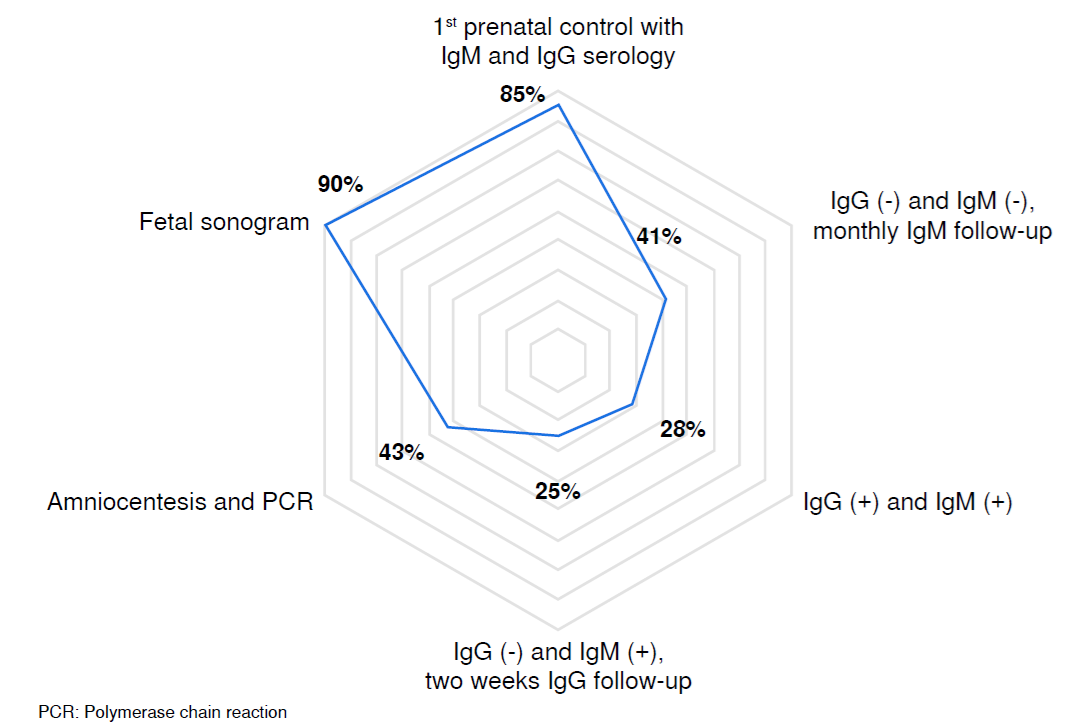
Results. Two hundred and forty-seven children were included; 17% had a confirmed congenital toxoplasmosis diagnosis. Adherence to the different clinical practice guidelines recommendations was variable. To diagnose gestational toxoplasmosis, immunoglobulins G and M serologies were ordered in 85.4% of the cases. Use of other diagnostic tests – depending on the clinical situation– ranged from 20 to 41.5%; amniocentesis was indicated in 42.9% of pregnant women, whereas IgM, IgG, and IgA were ordered for 50.6% of newborns. Spiramycin was prescribed to 68.8% of mothers diagnosed with gestational toxoplasmosis. Among patients diagnosed with congenital toxoplasmosis, 80.9% presented clinical
manifestations; the most common were those of the central nervous system. The highest adherence to the clinical practice guidelines was observed for the treatment of congenital toxoplasmosis (96.7%).
Conclusions. Adherence to the recommendations of the Colombian clinical practice guidelines for congenital and gestational toxoplasmosis is variable, likely due to implementation barriers, such as limited dissemination, insufficient training or updates for healthcare personnel, and challenges in accessing diagnostic studies and ensuring followup. We recommend developing institutional and government policies to provide periodic updates to prenatal care and newborn care personnel.
Downloads
References
Guedez IV, Barroso LA. Caracterización del tratamiento de la toxoplasmosis gestacional. Rev Salud Vive. 2020;3:69-76. https://doi.org/10.33996/revistavive.v3i8.44
Gómez-Sánchez PI, Arévalo-Rodríguez I, Rubio-Romero JA, Guío JA, Osorio-Castaño JH, Buitrago-Gutiérrez G, et al. Guías de Práctica Clínica para la prevención, detección temprana y tratamiento de las complicaciones del embarazo, parto o puerperio. Sección Toxoplasmosis. Bogotá: Ministerio de Salud y Protección Social – Colciencias; 2013. p. 369-400.
Cañón-Franco WA, López-Orozco N, Gómez-Marín JE, Dubey JP. An overview of seventy years of research (1944 - 2014) on toxoplasmosis in Colombia, South America. Parasit Vectors. 2014;7:427. https://doi.org/10.1186/1756-3305-7-427
Franco PS, Morais AC, Silva RJ, Araujo TE, Gonzaga HT, Ferreira C, et al. Systematic review and meta-analysis of congenital toxoplasmosis diagnosis: Advances and challenges. J Trop Med. 2024;1:1-27. https://doi.org/10.1155/2024/1514178
Rosso F, Agudelo A, Isaza Á, Montoya JG. Congenital toxoplasmosis: Clinical and epidemiological aspects of the infection during pregnancy. Colomb Med (Cali). 2007;38:316-37.
Maldonado YA, Read JS, Byington CL, Barnett ED, Davies HD, Edwards KM, et al. Diagnosis, treatment, and prevention of congenital toxoplasmosis in the United States. Pediatrics. 2017;139:1-52. https://doi.org/10.1542/peds.2016-3860
Thiébaut R, Leproust S, Chêne G, Gilbert R, SYROCOT (Systematic Review on Congenital Toxoplasmosis) Study Group. Effectiveness of prenatal treatment for congenital toxoplasmosis: A meta-analysis of individual patients’ data. Lancet. 2007;369:115-22. https://doi.org/10.1016/S0140-6736(07)60072-5
Rueda-Páez YS, Valbuena-Ruiz L, Quintero-Pimiento N, Pinilla-Plata A, Sayago-Silva J. Toxoplasmosis congénita, una mirada en la actualidad del tratamiento; revisión de la literatura. MedUNAB. 2019;22:51-63. https://doi.org/10.29375/01237047.2612
Cortés JA, Gómez JE, Silva PI, Arévalo L, Arévalo I, Álvarez MI, et al. Integral Care Guidelines for the prevention, early detection and treatment of pregnancy, partum, and puerperium complications: Section on toxoplasmosis in pregnancy. Infectio. 2012;16:230-46. https://doi.org/10.1016/S0123-9392(12)70018-8
Barrera A, Castiblanco P, Gómez MJ, López M, Ruiz A, Moncada L, et al. Toxoplasmosis adquirida durante el embarazo en el Instituto Materno Infantil en Bogotá. Rev Public Health. 2002;4:286-93.
Bollani L, Auriti C, Achille C, Garofoli F, De Rose DU, Meroni V, et al. Congenital toxoplasmosis: The state of the art. Front Pediatr. 2022;10:1-12. https://doi.org/10.3389/fped.2022.894573
Peyron F, L’ollivier C, Mandelbrot L, Wallon M, Piarroux R, Kieffer F, et al. Maternal and congenital toxoplasmosis: Diagnosis and treatment recommendations of a French multidisciplinary working group. Pathogens. 2019;8:1-15. https://doi.org/10.3390/pathogens8010024
Cabra-Bautista G, Paz-Córdoba BE, Henao-Pabón T, Bravo AM, Flórez ID, Delgado-Noguera M, et al. Quality of clinical practice guidelines for gestational and congenital toxoplasmosis: A systematic review of the literature. J Eval Clin Pract. 2022;28:218-24. https://doi.org/10.1111/jep.13612
Cogollo-Jiménez S, Díaz Restrepo E, Pérez Capachero M. Compliance with the Clinical Practice Guideline for Congenital Toxoplasmosis in Colombia in the last twenty years (tesis). Montería: Universidad de Córdoba; 2020.
Wang T, Tan J, Liu XL, Zhao I. Barriers and enablers to implementing clinical practice guidelines in primary care: An overview of systematic reviews. BMJ Open. 2023;13: e062158. https://doi.org/10.1136/bmjopen-2022-062158
Liu XL, Wang T, Tan JY, Stewart S, Chan RJ, Eliseeva S, et al. Sustainability of healthcare professionals’ adherence to clinical practice guidelines in primary care. BMC Prim Care. 2022;23:1-17. https://doi.org/10.1186/s12875-022-01641-x
Mejía-Oquendo M, Marulanda-Ibarra E, Gómez-Marín JE. Evaluation of the impact of the first evidence-based guidelines for congenital toxoplasmosis in Armenia (Quindío) Colombia: An observational retrospective analysis. Lancet Reg Heal-Am. 2021;1:100010. https://doi.org/10.1016/j.lana.2021.100010
Peyron F, Mc Leod F, Ajzenberg D, Contopoulos-Ioannidis D, Kieffer F, Mandelbrot L, et al. Congenital toxoplasmosis in France and the United States: One parasite, two diverging approaches. PLoS Negl Trop Dis. 2017;11:1-6. https://doi.org/10.1371/journal.pntd.0005222
Hernández A, Thota P, Pellegrino D, Pasupuleti V, Benites-Zapata V, Deshpande A, et al. A systematic review and meta-analysis of the relative efficacy and safety of treatment regimens for HIV- associated cerebral toxoplasmosis: Is trimethoprim- sulfamethoxazole a real option? HIV Med. 2017;18:115-24. https://doi.org/10.1111/hiv.12402
Cortés LJ. Guía para la vigilancia por laboratorio de Toxoplasma gondii. Bogotá, D.C.: Instituto Nacional de Salud; 2017. p. 1-19.
Baquero-Artigao F, Del Castillo F, Fuentes I, Goncé A, Fortuny C, Fernández-Miranda M, et al. Guide of the Spanish Society of Pediatric Infectious Diseases for the diagnosis and treatment of congenital toxoplasmosis. An Pediatr. 2013;79:116.e1-116e16. https://doi.org/10.1016/j.anpedi.2012.12.001
Araujo DR, Oliveira R, Soares C, Vieira WF, García LM. Knowledge gaps and educational opportunities in congenital toxoplasmosis: A narrative review of Brazilian and global perspectives. Trop Med Infect Dis. 2024;9:1-17 https://doi.org/10.3390/tropicalmed9060137
Some similar items:
- Jorge E. Collazo, R. Lopez, Dora Ginorio, Reina Liamos, R. Contreras, Anticuerpos IgG anti-toxoplasma gondii en pacientes con síntomas atribuíbles a toxoplasmosis , Biomedica: Vol. 13 No. 4 (1993)
- Armando Daniel Cortés, Natalia Aguirre, Severe disseminated acute toxoplasmosis in an adult immunocompetent patient from the Colombian Pacific , Biomedica: Vol. 38 No. Sup. 2 (2018): Suplemento 2, Medicina tropical
- Angélica María Ramírez, Yesmit Karina Ríos, Néstor Fabián Galvis, Elsie Entrena, Nidia Victoria Mariño, Diana Marcela Rangel, María Alejandra Araque, Darlis Mayerlis Cabarique, Mateo Murillo , Jorge Enrique Gómez-Marín, Seroprevalence and molecular detection of Toxoplasma gondii among donors in a blood bank in Cúcuta, Colombia Introduction: Toxoplasma gondii infection , Biomedica: Vol. 39 No. Supl. 2 (2019): Enfermedades transmisibles en el trópico, agosto
- Sebastián Posada-Bustos, Ana Cristina Mariño , Eugenia Espinosa-García , Clinical outcomes of pediatric patients with congenital toxoplasmosis in a fourthlevel center Introduction. Congenital , Biomedica: Vol. 44 No. 4 (2024)
- Raúl Reyes-Toledo , Laura Culma-Roa , María José López , Jairo Enrique Pérez , David Suárez-Silva , Outbreak of toxoplasmosis with pulmonary involvement in immunocompetent military population , Biomedica: Vol. 46 No. 1 (2026): Publicación anticipada
Copyright (c) 2025 Biomedica

This work is licensed under a Creative Commons Attribution 4.0 International License.
| Article metrics | |
|---|---|
| Abstract views | |
| Galley vies | |
| PDF Views | |
| HTML views | |
| Other views | |