

Identification of a variant in the USH1G gene in a family with Usher syndrome
Abstract
Usher syndrome is characterized by congenital sensorineural hearing loss, retinitis pigmentosa, and vestibular dysfunction. It is the most common cause of deafblindness worldwide. It is classified into three clinical types and twelve genetic subtypes.
We report a case of a family affected by Usher syndrome due to a variant in the USH1G gene, coding for the SANS protein. The ocular and auditory tests were performed for clinical confirmation of the diagnosis. The molecular study consisted of a next-generation sequencing panel containing 14 genes associated with Usher syndrome: MYO7A, USHC1, CDH23, PCDH15, USHG1, CIB2, USH2A, ADGRV1, WHRN, CLRN1, HARS, PDZD7, CEP250, C2orf71.
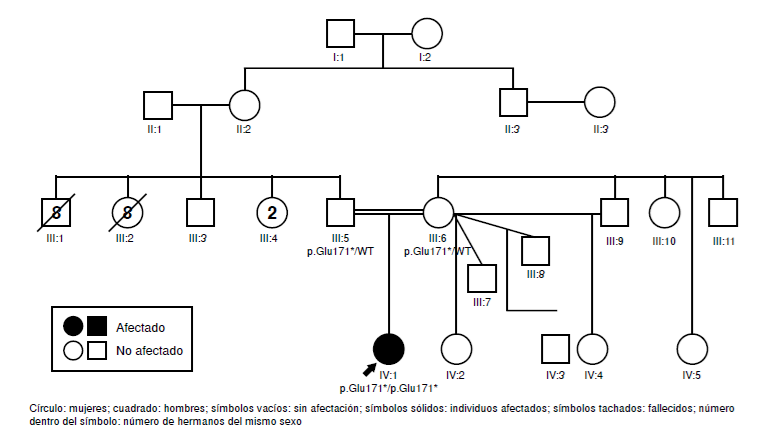
We present the case of a 13-year-old girl from a consanguineous Colombian family diagnosed with Usher syndrome type 1G. Clinical evaluations confirmed auditory, vestibular, and ocular alterations. Molecular analysis identified the homozygous p.Glu171Ter variant in the USH1G gene.
We highlight the importance of an early diagnosis of Usher syndrome. Although the variant frequency in the USH1G gene is low, it should not be underestimated; the exact etiology must be identified in these families. We recommend establishing a panel with Colombianspecific variants to perform more accurate Usher syndrome diagnoses, and in the future, to guide the development of gene therapies.
Downloads
References
Tamayo M, Bernal JE, Tamayo GE, Frías JL. Study of the etiology of deafness in an institutionalized population in Colombia. Am J Med Genet.1992;44:405-8. https://doi.org/10.1002/ajmg.1320440403
Tamayo ML, Bernal JE, Tamayo GE, Frías JL, Alvira G, Vergara O, et al. Usher syndrome: Results of a screening program in Colombia. Clin Genet. 1991;40:304-11. https://doi.org/10.1111/j.1399-0004.1991.tb03100.x
Hope CI, Bundey S, Proops D, Fielder AR. Usher syndrome in the city of Birmingham--prevalence and clinical classification. Br J Ophthalmol. 1997;81:46-53. https://doi.org/10.1136/bjo.81.1.46
Spandau UH, Rohrschneider K. Prevalence and geographical distribution of Usher syndrome in Germany. Graefes Arch Clin Exp Ophthalmol. 2002;240:495-8. https://doi.org/10.1007/s00417-002-0485-8
Keats BJ, Corey DP. The Usher syndromes. Am J Med Genet. 1999;89:158-66. https://doi.org/10.1002/(SICI)1096-8628(19990924)89:3<158::AIDAJMG6>3.0.CO;2-%23
Yoshimura H, Miyagawa M, Kumakawa K, Nishio SY, Usami S. Frequency of Usher syndrome type 1 in deaf children by massively parallel DNA sequencing. J Hum Genet. 2016;61:419-22. https://doi.org/10.1038/jhg.2015.168
Yan D, Liu XZ. Genetics and pathological mechanisms of Usher syndrome. J Hum Genet. 2010;55:327-35. https://doi.org/10.1038/jhg.2010.29
Hope CI, Bundey S, Proops D, Fielder AR. Usher syndrome in the city of Birmingham--prevalence and clinical classification. Br J Ophthalmol. 1997;81:46-53. https://doi.org/10.1136/bjo.81.1.46
Rosenberg T, Haim M, Hauch AM, Parving A. The prevalence of Usher syndrome and other retinal dystrophy-hearing impairment associations. Clin Genet. 1997;51:314-21. https://doi.org/10.1111/j.1399-0004.1997.tb02480.x
Weil D, El-Amraoui A, Masmoudi S, Mustapha M, Kikkawa Y, Laine S, et al. Usher síndrome type I G (USH1G) is caused by mutations in the gene encoding SANS, a protein that associates with the USH1C protein, harmonin. Hum Mol Genet. 2003;12:463-71. https://doi.org/10.1093/hmg/ddg051
Jaijo T, Aller E, García-García G, Aparisi MJ, Bernal S, Ávila-Fernández A, et al. Microarraybased mutation analysis of 183 Spanish families with Usher syndrome. Invest Ophthalmol Vis Sci. 2010;51:1311-7. https://doi.org/10.1167/iovs.09-4085
Mustapha M, Chouery E, Torchard-Pagnez D, Nouaille S, Khrais A, Sayegh FN, et al. A novel locus for Usher syndrome type I, USH1G, maps to chromosome 17q24-25. Hum Genet. 2002;110:348-50. https://doi.org/10.1007/s00439-002-0690-x
Ouyang XM, Yan D, Du LL, Hejtmancik JF, Jacobson SG, Nance WE, et al. Characterization of Usher syndrome type I gene mutations in an Usher syndrome patient population. Hum Genet. 2005;116:292-9. https://doi.org/10.1007/s00439-004-1227-2
Kikkawa Y, Shitara H, Wakana S, Kohara Y, Takada T, Okamoto M, et al. Mutations in a new scaffold protein SANS cause deafness in Jackson shaker mice. Hum Mol Genet. 2003;12:453-61. https://doi.org/10.1093/hmg/ddg042
Kalay E, de Brouwer AP, Caylan R, Nabuurs SB, Wollnik B, Karaguzel A, et al. A novel D458V mutation in the SANS PDZ binding motif causes atypical Usher syndrome. J Mol Med. 2005;83:1025-32. https://doi.org/10.1007/s00109-005-0719-4
Kimberling WJ, Moller C. Clinical and molecular genetics of Usher syndrome. J Am Acad Audiol. 1995;6:63-72. https://doi.org/10.1111/j.1399-0004.1991.tb03100.x
Kimberling WJ, Hildebrand MS, Shearer AE, Jensen ML, Halder JA, Trzupek K, et al. Frequency of Usher syndrome in two pediatric populations: Implications for genetic screening of deaf and hard of hearing children. Genet Med. 2010;12:512-6. https://doi.org/10.1097/GIM.0b013e3181e5afb8
Fortnum HM, Summerfield AQ, Marshall DH, Davis AC, Bamford JM. Prevalence of permanent childhood hearing impairment in the United Kingdom and implications for universal neonatal hearing screening: Questionnaire based ascertainment study. BMJ 2001;323:536-40. https://doi.org/10.1136/bmj.323.7312.536
Bashir R, Fatima A, Naz S. A frameshift mutation in SANS results in atypical Usher syndrome. Clin Genet. 2010;78:601-3. https://doi.org/10.1111/j.1399-0004.2010.01500.x
Some similar items:
- Leonardo F. Jurado, Martha I. Murcia, Patricia Hidalgo, John E. Leguizamón, Lorena R. González, Phenotypic and genotypic diagnosis of bone and miliary tuberculosis in an HIV+ patient in Bogotá, Colombia , Biomedica: Vol. 35 No. 1 (2015)
- Luis Enrique Paternina, Daniel Verbel-Vergara, Eduar Elías Bejarano, Comparison of 16S and COX1 genes mitochondrial regions and their usefulness for genetic analysis of ticks (Acari: Ixodidae) , Biomedica: Vol. 36 No. 2 (2016)
- Andrea Casas-Vargas, Liza M. Romero, William Usaquén, Sara Zea, Margarita Silva, Ignacio Briceño, Alberto Gómez, José Vicente Rodríguez, Mitochondrial DNA diversity in prehispanic bone remains on the eastern Colombian Andes , Biomedica: Vol. 37 No. 4 (2017)
- Juan J. Yunis, Luis E. Acevedo, David S. Campo, Emilio J. Yunis, Geno-geographic origin of Y-specific STR haplotypes in a sample of Caucasian-Mestizo and African-descent male individuals from Colombia , Biomedica: Vol. 33 No. 3 (2013)
- Harvy Mauricio Velasco, Lina Patricia Buelvas, Characterization of patients with skeletal genetic diseases in a Colombian referral center , Biomedica: Vol. 37 No. 2 (2017)
- Elizabeth Borrero, Gabriel Carrasquilla, Neal Alexander, Decentralization and health system reform: What is their impact on malaria incidence in Colombian municipalities? , Biomedica: Vol. 32 (2012): Suplemento 1, Malaria
- Gabriel Bedoya, Jenny García, Patricia Montoya, Winston Rojas, Maria Eugenia Amézquita, Iván Soto, Maria Cecilia López, Jorge Ospina-Duque, Andrés Ruiz-Linares, Isonymy analysis between 2 populations in northwestern Colombia , Biomedica: Vol. 26 No. 4 (2006)
- Sandra Lorena Girón, Julio César Mateus, Fabián Méndez, Impact of an open waste disposal site on the occurrence of respiratory symptoms and on health care costs of children , Biomedica: Vol. 29 No. 3 (2009)
- Patricia Escobar, Katherine Paola Luna, Indira Paola Hernández, César Mauricio Rueda, María Magdalena Zorro, Simon L. Croft, In vitro susceptibility of Trypanosoma cruzi strains from Santander, Colombia, to hexadecylphosphocholine (miltefosine), nifurtimox and benznidazole , Biomedica: Vol. 29 No. 3 (2009)
- Gustavo Pradilla, Julio César Mantilla, Reynaldo Badillo, Human rabies encephalitis by a vampire bat bite in an urban area of Colombia , Biomedica: Vol. 29 No. 2 (2009)
Copyright (c) 2025 Biomedica

This work is licensed under a Creative Commons Attribution 4.0 International License.
| Article metrics | |
|---|---|
| Abstract views | |
| Galley vies | |
| PDF Views | |
| HTML views | |
| Other views | |
Funding data