

Lymphoproliferation and hyper-IgM as the first manifestation of activated phosphoinositide 3-kinase δ syndrome: A case report
Abstract
Activated phosphoinositide 3-kinase δ syndrome is an inborn error of immunity due to mutations within the genes responsible for encoding PI3Kδ subunits. This syndrome results in an excessive activation of the phosphoinositide 3-kinase signaling pathway. Gainof-function mutations in the gene PIK3R1 (encoding p85α, p55α, and p50α) lead to the development of the activated PI3K δ syndrome. Notably, the clinical presentations of this syndrome often closely resemble those of other primary immunodeficiencies.
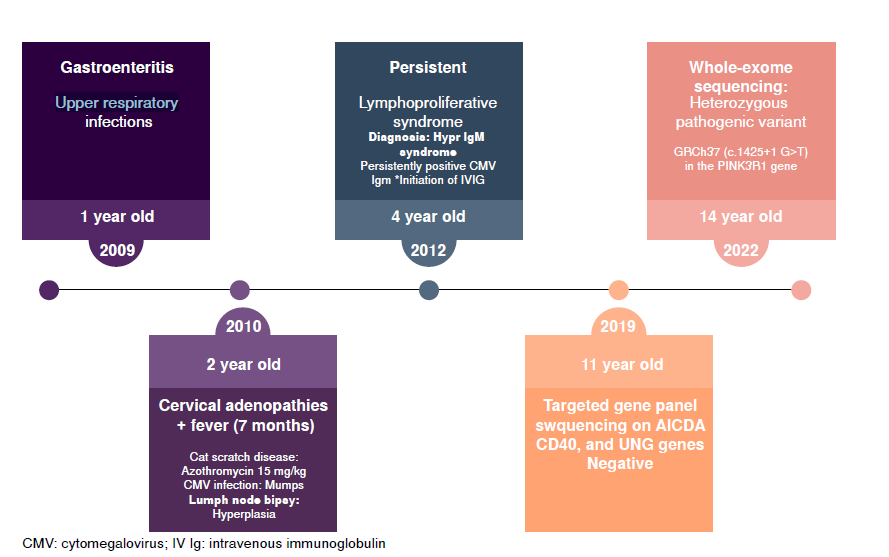
We present a case involving a 15-year-old male who displayed an immunological phenotype that bore a striking resemblance to hyper-IgM syndrome. Whole exome
sequencing was undertaken to pinpoint the underlying genetic mutation.
Our investigation successfully identified a heterozygous splice site mutation previously reported within the well-established hotspot of the PIK3R1 gene (GRCh37, c.1425+1 G>T). The diverse spectrum of inborn errors of immunity underscores the pivotal role of identifying gene mutations, particularly in patients presenting clinical manifestations spanning autoimmune disorders, lymphoproliferative conditions, and antibody deficiencies. Such precise genetic diagnoses hold significant potential for improving patient care and management.
Downloads
References
Nguyen T, Lau A, Bier J, Cooke KC, Lenthall H, Ruiz-Diaz S, et al. Human PIK3R1 mutations disrupt lymphocyte differentiation to cause activated PI3Kδ syndrome 2. J Exp Med. 2023;220:e20221020. https://doi.org/10.1084/jem.20221020
Lucas CL, Kuehn HS, Zhao F, Niemela JE, Deenick EK, Palendira U, et al. Dominantactivating germline mutations in the gene encoding the PI(3)K catalytic subunit p110δ result in T cell senescence and human immunodeficiency. Nat Immunol. 2014;15:88-97. https://doi.org/10.1038/ni.2771
Singh A, Joshi V, Jindal AK, Mathew B, Rawat A. An updated review on activated PI3 kinase delta syndrome (APDS). Genes Dis. 2020;7:67-74. https://doi.org/10.1016/j.gendis.2019.09.015
Okkenhaug K, Vanhaesebroeck B. PI3K in lymphocyte development, differentiation and activation. Nat Rev Immunol. 2003;3:317-30. https://doi.org/10.1038/nri1056
Redenbaugh V, Coulter T. Disorders related to PI3Kδ hyperactivation: Characterizing the clinical and immunological features of activated PI3-kinase delta syndromes. Front Pediatr. 2021;9. https://doi.org/10.3389/fped.2021.702872
Yazdani R, Hamidi Z, Babaha F, Azizi G, Fekrvand S, Abolhassani H, et al. PIK3R1 mutation associated with hyper IgM (APDS2 syndrome): A case report and review of the literature. Endocr Metab Immune Disord Drug Targets. 2019;19:941-58. https://doi.org/10.2174/1871530319666190225114739
Condliffe AM, Chandra A. respiratory manifestations of the activated phosphoinositide 3-kinase delta syndrome. Front Immunol. 2018;9. https://doi.org/10.3389/fimmu.2018.00338
Durandy A, Kracker S. Increased activation of PI3 kinase-δ predisposes to B-cell lymphoma. Blood. 2020;135:638-43. https://doi.org/10.1182/blood.2019002072
Jamee M, Moniri S, Zaki-Dizaji M, Olbrich P, Yazdani R, Jadidi-Niaragh F, et al. Clinical, immunological, and genetic features in patients with activated PI3Kδ syndrome (APDS): A systematic review. Clin Rev Allergy Immunol. 2020;59:323-33. https://doi.org/10.1007/s12016-019-08738-9
Lucas CL, Zhang Y, Venida A, Wang Y, Hughes J, McElwee J, et al. Heterozygous splice mutation in PIK3R1 causes human immunodeficiency with lymphoproliferation due to dominant activation of PI3K. J Exp Med. 2014;211:2537-47. https://doi.org/10.1084/jem.20141759
Lougaris V, Faletra F, Lanzi G, Vozzi D, Marcuzzi A, Valencic E, et al. Altered germinal center reaction and abnormal B cell peripheral maturation in PI3KR1-mutated patients presenting with HIGM-like phenotype. Clin Immunol. 2015;159:33-6. https://doi.org/10.1016/j.clim.2015.04.014
Ewertowska M, Grześk E, Urbańczyk A, Dąbrowska A, Bąbol-Pokora K, Łęcka M, et al. Activated phosphoinositide 3-kinase delta syndrome 1 and 2 (APDS 1 and APDS 2): Similarities and differences based on clinical presentation in two boys. Allergy Asthma Clin Immunol. 2020;16:22. https://doi.org/10.1186/s13223-020-00420-6
Bousfiha A, Moundir A, Tangye SG, Picard C, Jeddane L, Al-Herz W, et al. The 2022 update of IUIS phenotypical classification for human inborn errors of immunity. J Clin Immunol. 2022;42:1508-20. https://doi.org/10.1007/s10875-022-01352-z
Maccari ME, Wolkewitz M, Schwab C, Lorenzini T, Leiding JW, Aladjdi N, et al. Activated Phosphoinositide 3-Kinase δ Syndrome: Update from the ESID Registry and comparison with other autoimmune-lymphoproliferative inborn errors of immunity. J Allergy Clin Immunol. 2023t;152:984-96.e10. https://doi.org/10.1016/j.jaci.2023.06.015
Dorsey MJ, Condino-Neto A. Improving access to therapy for patients with inborn errors of immunity: A call to action. J Allergy Clin Immunol Pract. 2023;11:1698-702. https://doi.org/10.1016/j.jaip.2023.04.019
Rao VK, Webster S, Šedivá A, Plebani A, Schuetz C, Shcherbina A, et al. A randomized, placebo-controlled phase 3 trial of the PI3Kδ inhibitor leniolisib for activated PI3Kδ syndrome. Blood. 2023;141:971-83. https://doi.org/10.1182/blood.2022018546
Cant AJ, Chandra A, Munro E, Rao VK, Lucas CL. PI3Kδ Pathway dysregulation and unique features of its inhibition by leniolisib in activated PI3Kδ syndrome and beyond. J Allergy Clin Immunol Pract. 2024;12:69-78. https://doi.org/10.1016/j.jaip.2023.09.016
Seidel MG, Kindle G, Gathmann B, Quinti I, Buckland M, van Montfrans J, et al. The European Society for Immunodeficiencies (ESID) Registry working definitions for the clinical diagnosis of inborn errors of immunity. J Allergy Clin Immunol Pract. 2019;7:1763-70. https://doi.org/10.1016/j.jaip.2019.02.004
Some similar items:
- Ana María Navarro , Gabriela Mantilla, Jorge Andrés Fernández , Mario Fernando Unigarro, Alfonso Suárez , María Claudia Ortega , Severe immunodeficiency spectrum associated with NHEJ1 gene mutation: Cernunnos/XLF deficiency , Biomedica: Vol. 44 No. Sp. 2 (2024): Inmunología clínica
- Nelsy Loango, Martha Lucía Gallego, Beatriz Restrepo, Patricia Landázuri, Gender, age and plasma lipids differences associated with apolipoprotein E polymorphism in school children , Biomedica: Vol. 29 No. 3 (2009)
- Mercedes Salcedo-Cifuentes, Jesús Cabrera, Yesid Cuesta-Astroz, Edwin Carrascal, Yoshito Eizuru, Martha C. Domínguez, Adalberto Sánchez, Felipe García-Vallejo, Clonal expansion and genomic characterization of the human T-cell lymphotropic virus type I during the integration process in adult T-cell leukemia/lymphoma , Biomedica: Vol. 29 No. 2 (2009)
- Felipe García, Martha C. Domínguez, Miyerlandi Torres, Óscar Tamayo, William Criollo, Milton Quintana, Adalberto Sánchez, Autoimmune syndrome in the tropical spastic paraparesis/myelopathy associated with human T-lymphotropic virus infections , Biomedica: Vol. 28 No. 4 (2008)
- Ney Callas, Elpidia Poveda, César Baracaldo, Patricia Hernández, Carlina Castillo, Martha Guerra, Genetic polymorphism of the E apolipoprotein in school age children: comparison with levels of plasma lipids and apolipoproteins , Biomedica: Vol. 27 No. 4 (2007)
- Nelson Grisales, Omar Triana, Víctor Angulo, Nicolás Jaramillo, Gabriel Parra-Henao, Francisco Panzera, Andrés Gómez-Palacio, Genetic differentiation of three Colombian populations of Triatoma dimidiata (Heteroptera: Reduviidae) by ND4 mitochondrial gene molecular analysis , Biomedica: Vol. 30 No. 2 (2010)
- Andrés Javier Quiroga, Antonio Huertas, Alba Lucía Cómbita, María Mercedes Bravo, Variation in the number of EPIYA-C repeats in CagA protein from Colombian Helicobacter pylori strains and its ability to induce hummingbird phenotype in gastric epithelial cells , Biomedica: Vol. 30 No. 2 (2010)
- Claudia Ayala, Reggie García, Edith Cruz, Karol Prieto, Marta Bermúdez, Homocysteine levels and polymorphisms of MTHFR and CBS genes in Colombian patients with superficial and deep venous thrombosis , Biomedica: Vol. 30 No. 2 (2010)
- Zaava Ravid, Sofía Duque, Adriana Arévalo, Rubén Santiago Nicholls, Moisés Wasserman, Genetic diversity of Giardia intestinalis populations in Colombia , Biomedica: Vol. 27 No. 1 (2007)
- Olga María Moreno, Clara Isabel González, Diego Luis Saaibi, William Otero, Reynaldo Badillo, Javier Martín, Gerardo Ramírez, Polymorphisms of IL-10 gene promoter and rheumatoid arthritis in a Colombian population , Biomedica: Vol. 27 No. 1 (2007)
Copyright (c) 2024 Biomedica

This work is licensed under a Creative Commons Attribution 4.0 International License.
| Article metrics | |
|---|---|
| Abstract views | |
| Galley vies | |
| PDF Views | |
| HTML views | |
| Other views | |