

Lionfish envenomation case treated in an emergency unit in Colombia
Abstract
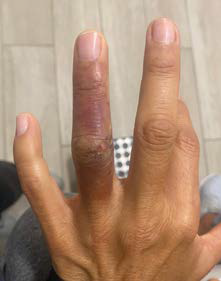
The lionfish (Pterois volitans) is an invasive species in the Caribbean Sea that can accidentally inject venom into humans through its spines. Here, we report a case of lionfish envenomation, highlighting a potential emerging threat to public health in Colombia. The case describes a healthy 59-year-old woman who suffered an accidental sting on the fourth finger of her left hand after contact with a lionfish spin while diving in Aruba.
On-site treatment included hot compresses, antihistamines, and systemic corticosteroids. However, the patient experienced severe pain, coldness, and paleness in the affected finger. One day later, the patient traveled to Bogotá, Colombia, and developed swelling, loss of sensitivity, and changes in skin coloration. In the emergency unit, the patient received pharmacological treatment with 100 mg of aspirin administered orally and 60 mg of enoxaparin administered subcutaneously; also, a calcium antagonist was prescribed for vasospasm management (30 mg of nifedipine 30 administered orally), and complementary studies were ordered. Paraclinical results were normal, and the Doppler ultrasound of the
left upper limb arterial vessels showed no abnormalities. The treatment was successful, and the patient fully recovered.
Given the novelty of this affection for our country, the patient’s favorable evolution after latestage pharmacological management, and the limitations of the initial treatment, we present a broad discussion based on the review of related literature.
Downloads
References
1. Norton BB, Norton SA. Lionfish envenomation in Caribbean and Atlantic waters: Climate change and invasive species. Int J Womens Dermatol. 2021;7:120-3. https://doi.org/10.1016/j.ijwd.2020.05.016
2. Escobar Román R, Leiva Acebey L, Sorí León Y. Pez león (Pterois volitans) y su impacto en la salud humana. Gac Med Espirit. 2015;17:82-92.
3. Marineros L. Incidencia y primeros accidentes del pez león (Pterois volitans) en aguas continentales del Caribe de Honduras. Bioma. 2014;15:29-35.
4. Vetrano SJ, Lebowitz JB, Marcus S. Lionfish envenomation. J Emerg Med. 2002;23:379-82. https://doi.org/10.1016/s0736-4679(02)00572-3
5. Garyfallou GT, Madden JF. Lionfish envenomation. Ann Emerg Med. 1996;28:456-7. https://doi.org/10.1016/s0196-0644(96)70018-5
6. Pastore D, Pacifici F, Ciao G, Bedin V, Pasquantonio G, Della-Morte D. Far infrared technology (FIT) therapy patches protect from inflammation, oxidative stress, and promote cellular vitality. Curr Pharm Des. 2020;26:4323-9. https://doi.org/10.2174/1381612826666200427112023
7. Hardison DR, Holland WC, Darius HT, Chinain M, Tester PA, Shea D, et al. Investigation of ciguatoxins in invasive lionfish from the greater Caribbean region: Implications for fishery development. PLoS ONE. 2018;13:e0198358. https://doi.org/10.1371/journal.pone.0198358
8. Schult RF, Acquisto NM, Stair CK, Wiegand TJ. A case of lionfish envenomation presenting to an inland emergency department. Case Rep Emerg Med. 2017;2017:5893563. https://doi.org/10.1155/2017/5893563
9. Pérez Bravo Á. Análisis preliminar de los componentes proteicos del veneno del pez león Pterois volitans de la costa de Santa Marta y evaluación de su actividad biológica. Bogotá: Universidad Nacional de Colombia; 2018.
10. Rensch G, Murphy-Lavoie HM. Lionfish, scorpionfish, and stonefish toxicity. Treasure Island (FL): StatPearls Publishing; 2023.
11. Haddad V, Stolf HO, Risk JY, França FOS, Cardoso JLC. Report of 15 injuries caused by lionfish (Pterois volitans) in aquarists in Brazil: A critical assessment of the severity of envenomations. J Venom Anim Toxins Incl Trop Dis. 2015:21:8. https://doi.org/10.1186/s40409-015-0007-x
12. Resiere D, Cerland L, De Haro L, Valentino R, Criquet-Hayot A, Chabartier C, et al. Envenomation by the invasive Pterois volitans species (lionfish) in the French West Indies--A two-year prospective study in Martinique. Clin Toxicol (Phila). 2016;54:313-8. https://doi.org/10.3109/15563650.2016.1143100
13. Mouchbahani-Constance S, Lesperance LS, Petitjean H, Davidova A, Macpherson A, Prescott SA, et al. Lionfish venom elicits pain predominantly through the activation of non-peptidergic nociceptors. Pain. 2018;159:2255-66. https://doi.org/10.1097/j.pain.0000000000001326
14. Latremoliere A, Woolf CJ. Central sensitization: A generator of pain hypersensitivity by central neural plasticity. J Pain. 2009;10:895-926. https://doi.org/10.1016/j.jpain.2009.06.012
15. Montoya-Giraldo MA, Díaz LF, Gómez UE, Quintero J, Zuluaga AF. Use of low-molecular weight heparin in severe paraquat poisoning: A case report. J Med Case Rep. 2020;14:240. https://doi.org/10.1186/s13256-020-02565-9
16. Hobday D, Chadha P, Din AH, Geh J. Denaturing the lionfish. Eplasty. 2016;16:ic20.
17. Aktas S, Mirasoglu B. Lionfish envenomation: Clinical aspect and management. J Black Sea Mediterr Environ. 2017;23:81.
Some similar items:
- Carolina Firacative, Germán Torres, María Claudia Rodríguez, Patricia Escandón, First environmental isolation of Cryptococcus gattii serotype B, from Cúcuta, Colombia , Biomedica: Vol. 31 No. 1 (2011)
- Constanza Pardo, Ricardo Cendales, Survival analysis of cervical cancer patients , Biomedica: Vol. 29 No. 3 (2009)
- Raúl Murillo, Ricardo Cendales, Carolina Wiesner, Marion Piñeros, Sandra Tovar, Effectiveness of cytology-based cervical cancer screening in the Colombian health system , Biomedica: Vol. 29 No. 3 (2009)
- Sandra Lorena Girón, Julio César Mateus, Fabián Méndez, Impact of an open waste disposal site on the occurrence of respiratory symptoms and on health care costs of children , Biomedica: Vol. 29 No. 3 (2009)
- José Joaquín Carvajal, Ligia Inés Moncada, Mauricio Humberto Rodríguez, Ligia del Pilar Pérez, Víctor Alberto Olano, Characterization of Aedes albopictus (Skuse, 1894) (Diptera:Culicidae) larval habitats near the Amazon River in Colombia , Biomedica: Vol. 29 No. 3 (2009)
- Andrés Páez, Gloria Rey, Carlos Agudelo, Alvaro Dulce, Edgar Parra, Hernando Díaz-Granados, Damaris Heredia, Luis Polo, Outbreak of urban rabies transmitted by dogs in Santa Marta, northern Colombia , Biomedica: Vol. 29 No. 3 (2009)
- Patricia Escobar, Katherine Paola Luna, Indira Paola Hernández, César Mauricio Rueda, María Magdalena Zorro, Simon L. Croft, In vitro susceptibility of Trypanosoma cruzi strains from Santander, Colombia, to hexadecylphosphocholine (miltefosine), nifurtimox and benznidazole , Biomedica: Vol. 29 No. 3 (2009)
- Gustavo Pradilla, Julio César Mantilla, Reynaldo Badillo, Human rabies encephalitis by a vampire bat bite in an urban area of Colombia , Biomedica: Vol. 29 No. 2 (2009)
- Mauricio Beltrán, María Cristina Navas, María Patricia Arbeláez, Jorge Donado, Sergio Jaramillo, Fernando De la Hoz, Cecilia Estrada, Lucía del Pilar Cortés, Amalia de Maldonado, Gloria Rey, Seroprevalence of hepatitis B virus and human immunodeficiency virus infection in a population of multiply-transfused patients in Colombia , Biomedica: Vol. 29 No. 2 (2009)
- Rosa Magdalena Uscátegui, Adriana M. Correa, Jaime Carmona-Fonseca, Changes in retinol, hemoglobin and ferritin concentrations in Colombian children with malaria , Biomedica: Vol. 29 No. 2 (2009)
Copyright (c) 2025 Biomedica

This work is licensed under a Creative Commons Attribution 4.0 International License.
| Article metrics | |
|---|---|
| Abstract views | |
| Galley vies | |
| PDF Views | |
| HTML views | |
| Other views | |