

Cardiac disease discrimination from 3D-convolutional kinematic patterns on cine-MRI sequences
Abstract
Introduction. Cine-MRI (cine-magnetic resonance imaging) sequences are a key diagnostic tool to visualize anatomical information, allowing experts to localize and determine suspicious pathologies. Nonetheless, such analysis remains subjective and prone to diagnosis errors.
Objective. To develop a binary and multi-class classification considering various cardiac conditions using a spatiotemporal model that highlights kinematic movements to characterize each disease.
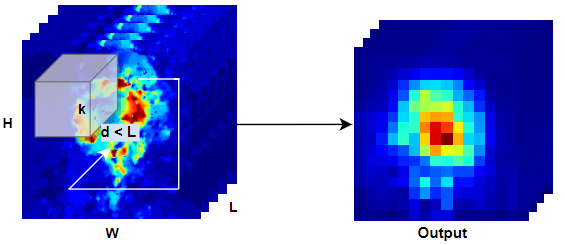
Materials and methods. This research focuses on a 3D convolutional representation to characterize cardiac kinematic patterns during the cardiac cycle, which may be associated with pathologies. The kinematic maps are obtained from the apparent velocity maps computed from a dense optical flow strategy. Then, a 3D convolutional scheme learns to differentiate pathologies from kinematic maps.
Results. The proposed strategy was validated with respect to the capability to discriminate among myocardial infarction, dilated cardiomyopathy, hypertrophic cardiomyopathy, abnormal right ventricle, and normal cardiac sequences. The proposed method achieves an average accuracy of 78.00% and a F1 score of 75.55%. Likewise, the approach achieved 92.31% accuracy for binary classification between pathologies and control cases.
Conclusion. The proposed method can support the identification of kinematically abnormal patterns associated with a pathological condition. The resultant descriptor, learned from the 3D convolutional net, preserves detailed spatiotemporal correlations and could emerge as possible digital biomarkers of cardiac diseases.
Downloads
References
World Health Organization. World Health Statistics 2021. Geneva: World Health Organization; 2021.
Cetin I, Sanroma G, Petersen SE, Napel S, Camara O, Ballester MA, et al. A radiomics approach to computer-aided diagnosis with cardiac cine-MRI. arXiv. 2019:1909.11854v1. https://doi.org/10.48550/arXiv.1909.11854
Chang Y, Jung C. Automatic cardiac MRI segmentation and permutation-invariant pathology classification using deep neural networks and point clouds. Neurocomputing. 2020;418:270-9. https://doi.org/10.1016/j.neucom.2020.08.0
Chang Y, Song B, Jung C, Huang L. Automatic segmentation and cardiopathy classification in cardiac MRI images based on deep neural networks. ICASSP. 2018;1020-4. https://doi.org/10.1109/ICASSP.2018.8461261
Khened M, Kollerathu VA, Krishnamurthi G. Fully convolutional multi-scale residual DenseNets for cardiac segmentation and automated cardiac diagnosis using ensemble of classifiers. Med Image Anal. 2019;51:21-45. https://doi.org/10.1016/j.media.2018.10.004
Puyol-Anton E, Ruijsink B, Gerber B, Amzulescu MS, Langet H, De Craene M, et al. Regional multi-view learning for cardiac motion analysis: Application to identification of dilated cardiomyopathy patients. IEEE Trans Biomed Eng. 2019;66:956-66. https://doi.org/10.1109/TBME.2018.2865669
Yang D, Wu P, Tan C, Pohl KM, Axel L, Metaxas DN. 3D motion modeling and reconstruction of left ventricle wall in cardiac MRI. Funct Imaging Model Heart. 2017:10263:481-92. https://doi.org/10.1007/978-3-319-59448-4_46
Isensee F, Jaeger PT, Full PM, Wolf I, Engelhardt S, Maier-Hein KH. Automatic cardiac disease assessment on cine-MRI via time-series segmentation and domain specific features. arXiv.2017:1707.00587v2. https://doi.org/10.48550/arXiv.1707.00587
Wolterink JM, Leiner T, Viergever MA, Išgum I. Automatic segmentation and disease classification using cardiac cine MR images. arXiv. 2017:1708.01141v1. https://doi.org/10.48550/arXiv.1708.01141
Qin C, Bai W, Schlemper J, Petersen SE, Piechnik SK, Neubauer S, et al. Joint motion estimation and segmentation from undersampled cardiac MR image. arXiv. 2019:1908.07623v1. https://doi.org/10.48550/arXiv.1908.07623
Zhen X, Wang Z, Islam A, Bhaduri M, Chan I, Li S. Multi-scale deep networks and regression forests for direct bi-ventricular volume estimation. Medical Image Analysis. 2016;30:120-9. https://doi.org/10.1016/j.media.2015.07.003
Punithakumar K, Ben Ayed I, Islam A, Goela A, Ross IG, Chong J, et al. Regional heart motion abnormality detection: An information theoretic approach. Medical Image Analysis. 2013;17:311-24. https://doi.org/10.1016/j.media.2012.11.007
Zheng Q, Delingette H, Ayache N. Explainable cardiac pathology classification on cine MRI with motion characterization by semi-supervised learning of apparent flow. Medical Image Analysis. 2019;56:80-95. https://doi.org/10.1016/j.media.2019.06.001
Brox T, Malik J. Large displacement optical flow: Descriptor matching in variational motion etimation. IEEE Trans Pattern Anal Mach Intell. 2011;33:500-13. https://doi.org/10.1109/TPAMI.2010.143
Varol G, Laptev I, Schmid C. Long-term temporal convolutions for action recognition. IEEE Trans Pattern Anal Mach Intell. 2018;40:1510-1517. https://doi.org/10.1109/TPAMI.2017.2712608
Bernard O, Lalande A, Zotti C, Cervenansky F, Yang X, Heng PA, et al. Deep learning techniques for automatic MRI cardiac multi-structures segmentation and diagnosis: Is the problem solved? IEEE Trans Med Imaging. 2018;37:2514-25. https://doi.org/10.1109/TMI.2018.2837502
Broncano J, Bhalla S, Caro P, Hidalgo A, Vargas D, Williamson E, et al. Cardiac MRI in patients with acute chest pain. Radiographics. 2021;41:8-31. https://doi.org/10.1148/rg.2021200084
Fotaki A, Puyol-Antón E, Chiribiri A, Botnar R, Pushparajah K, Prieto C. Artificial intelligence in cardiac MRI: Is clinical adoption forthcoming? Front Cardiovasc Med. 2022:8:818765. https://doi.org/10.3389/fcvm.2021.818765
Clough JR, Oksuz I, Puyol-Antón E, Bram Ruijsink, King AP, Schnabel JA. Global and local interpretability for cardiac MRI classification. Springer. 2019; 1767 LNCS:656-64. https://doi.org/10.1007/978-3-030-32251-9_72
Some similar items:
- María Clara Echeverry, Nubia Catalina Tovar, Guillermo Mora, Presence of antibodies to cardiac neuroreceptors in patients with Chagas disease , Biomedica: Vol. 29 No. 3 (2009)
- Lauro Figueroa-Valverde, Francisco Díaz-Cedillo, María López-Ramos, Elodia García-Cervera, Karen Quijano-Ascencio, Inotropic activity induced by carbamazepine-alkyne derivative in an isolated heart model and perfused to constant flow , Biomedica: Vol. 31 No. 2 (2011)
- Jorge H. Botero, Martha Nelly Montoya, Adriana Lucía Vanegas, Abel Díaz, Luis Navarro-i-Martínez, Fernando Jorge Bornay, Fernando Izquierdo, Carmen del Aguila, Sonia del Pilar Agudelo, Frequency of intestinal microsporidian infections in HIV-positive patients, as diagnosis by quick hot Gram chromotrope staining and PCR. , Biomedica: Vol. 24 No. 4 (2004)
- Luis Alberto Gómez, María Luz Gunturiz, Identification and differential expression of the microphthalmia-associated transcription factor in heart and isolated cardiomyocytes from Guinea pigs: Possible role in hypertrophy and viability , Biomedica: Vol. 34 No. 3 (2014)
- Germán Briceño, Jaime Céspedes, Martha Leal, Sarha Vargas, Prevalence of cardiovascular risk factors in schoolchildren from a rural and urban area in Colombia , Biomedica: Vol. 38 No. 4 (2018)
Copyright (c) 2024 Biomedica

This work is licensed under a Creative Commons Attribution 4.0 International License.
| Article metrics | |
|---|---|
| Abstract views | |
| Galley vies | |
| PDF Views | |
| HTML views | |
| Other views | |
Funding data
-
Vicerrectoría de Investigación y Extensión, Universidad Industrial de Santander
Grant numbers 2703;Predicción de patologías cardíacas utilizando representaciones de aprendizaje profundo en secuencias de resonancia magnética cardíaca (CMR)