

Hemorraghic skin syndrome associated with contact of Lonomia spp. caterpillar: First report from the Ecuadorian Amazon
Abstract
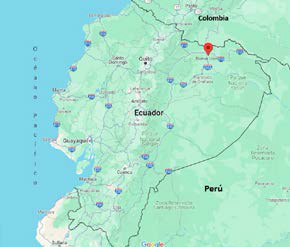
This is the first report of hemorrhagic cutaneous syndrome induced by contact with venomous caterpillars in a 29-year-old woman living in the northern Ecuadorian Amazon.
Reported cases of hemorrhagic cutaneous syndrome are rare and are characterized by dermal lesions, systemic bleeding, and coagulation abnormalities.
The woman had contact on her right thigh with caterpillars resting on the trunk of a tree which resulted in local irritation and pain, headache, dizziness, and vomiting. After 48 hours, ecchymosis occurred at the contact site, the neck, thorax, abdomen, and extremities. She was hospitalized and presented abundant vaginal bleeding and extended coagulation times with a normal platelet count. She was treated with paracetamol and tranexamic acid, achieving resolution of the bleeding and normalization of coagulation parameters. The patient was discharged in good condition; at the six-month follow-up, she remained asymptomatic.
Although Lonomia spp. caterpillars are recorded in the Ecuadorian Amazon, this is the first reported case. This report highlights the unavailability of antilonomic serum in the region, underlining the need for implementing strategies to guarantee serum access and promoting medical and community awareness of hemorrhagic cutaneous syndrome by contact with Lonomia spp. in endemic areas.
Downloads
References
1. Montalbán-Sandoval E, Bustinza-Álvarez A, Vílchez G, Olarte L, Velarde-Marca J, Maguiña-Vargas C. Erucismo por Lonomia spp. con síndrome cutáneo hemorrágico. Primer caso reportado en Perú –2006. Dermatol Peru. 2008;18:354-8.
2. Santos JH, Oliveira SS, Alves EC, Mendonça-da-Silva I, Sachett JA, Tavares A, et al. Severe hemorrhagic syndrome after Lonomia caterpillar envenomation in the Western Brazilian Amazon: How many more cases are there? Wilderness Environ Med. 2017;28:46-50. https://doi.org/10.1016/j.wem.2016.11.001
3. Hernández-Villarroel LA. Hemorrhagic syndrome associated with contact with Lonomia sp (Lepidoptera, Saturniidae) in Venezuela. Rev Cubana Med Trop. 2023;75:e1039.
4. González C, Ballesteros-Mejía L, Díaz-Díaz J, Toro-Vargas DM, Amarillo-Suárez AR, Gey D, et al. Deadly and venomous Lonomia caterpillars are more than the two usual suspects. PLoS Negl Trop Dis. 2023;17:e0011063. https://doi.org/10.1371/journal.pntd.0011063
5. Sano-Martins IS, Gonzalez C, Anjos IV, Díaz J, Goncalves LR. Effectiveness of Lonomia antivenom in recovery from the coagulopathy induced by Lonomia orientoandensis and Lonomia casanarensis caterpillars in rats. PLoS Negl Trop Dis. 2018;12:e0006721. https://doi.org/10.1371/journal.pntd.0006721
6. Lemaire C. Révision du genre Lonomia Walker (Lep. Attacidae). Ann Soc Ent Fr. 1972;8:707-861.
7. Fundação Nacional de Saúde - FUNASA. Manual de diagnóstico e tratamento de accidentes por animais peçonhentos. 2ª edição. Brasília: Fundação Nacional de Saúde; 2001. p. 120.
8. Da Silva WD, Campos CM, Gonçalves LR, Sousa-e-Silva MC, Higashi HG, Yamagushi IK, et al. Development of an antivenom against toxins of Lonomia obliqua caterpillars. Toxicon. 1996;34:1045-9. https://doi.org/10.1016/0041-0101(96)00052-9
9. Sánchez MN, Mignone Chagas MA, Casertano SA, Cavagnaro LE, Peichoto ME. Accidentes causados por la oruga Lonomia obliqua (Walker, 1855): un problema emergente. Medicina (B. Aires). 2015;75:328-33.
10. Mayence C, Mathien C, Sanna A, Houcke S, Tabard P, Roux A, et al. Lonomia caterpillar envenoming in French Guiana reversed by the Brazilian antivenom: A successful case of international cooperation for a rare but deadly tropical hazard. Toxicon. 2018;151:74-8. https://doi.org/10.1016/j.toxicon.2018.06.068
11. Pineda D, Amarillo A, Becerra J, Montenegro G. Síndrome hemorrágico por contacto con orugas del género Lonomia (Saturniidae) en Casanare, Colombia: informe de dos casos. Biomédica. 2001;21:328-32. https://doi.org/10.7705/biomedica.v21i4.1125
12. Gonçalves LR, Sousa-e-Silva MC, Tomy SC, Sano-Martins IS. Efficacy of serum therapy on the treatment of rats experimentally envenomed by bristle extract of the caterpillar Lonomia obliqua: Comparison with epsilon-aminocaproic acid therapy. Toxicon. 2007;50:349-56. https://doi.org/10.1016/j.toxicon.2007.04.004
13. Bryant-Smith AC, Lethaby A, Farquhar C, Hickey M. Antifibrinolytics for heavy menstrual bleeding. Cochrane Database Syst Rev. 2018;4:CD000249.
https://doi.org/10.1002/14651858.CD000249.pub214. World Health Organization. Report of the Seventeenth Meeting of the Strategic and Technical Advisory Group for Neglected Tropical Diseases, Geneva, Switzerland, 11–12 October 2023. Geneva: World Health Organization; 2024.
15. Ministerio de Salud Pública. Manejo clínico del envenenamiento por mordeduras de serpientes venenosas y picaduras de escorpiones: protocolo basado en evidencias. 1a edición. Quito: Dirección Nacional de Prevención y Control y Dirección Nacional de Normatización; 2017. p. 1-113.
16. Marval E, Guerrero B, Arocha-Piñango CL. The action of Lonomia achelous caterpillar venom on some blood coagulation and fibrinolysis parameters of the rabbit. Toxicon. 1999;37:1491-504. https://doi.org/10.1016/s0041-0101(99)00085-9
Some similar items:
- Guillermo Sánchez, John Nova, Reliability and reproducibility of the Fitzpatrick phototype scale for skin sensitivity to ultraviolet light , Biomedica: Vol. 28 No. 4 (2008)
- Sunny Sánchez, Dolores Zambrano, Maylen García, César Bedoya, Carlos Fernández, María Teresa Illnait-Zaragozí, Molecular characterization of Cryptococcus neoformans isolates from HIV patients, Guayaquil, Ecuador , Biomedica: Vol. 37 No. 3 (2017)
- Patricia Jiménez, Karina Calvopiña, Diana Herrera, Carlos Rojas, Laura Pérez-Lago, Marcelo Grijalva, Remedios Guna, Darío García-de Viedma, Identification of the Mycobacterium tuberculosis Beijing lineage in Ecuador , Biomedica: Vol. 37 No. 2 (2017)
- Jazzmín Arrivillaga-Henríquez, Sandra Enríquez, Vanessa Romero, Gustavo Echeverría, Jorge Pérez-Barrera, Ana Poveda, Juan-Carlos Navarro, Alon Warburg, Washington Benítez, Eco-epidemiological aspects, natural detection and molecular identification of Leishmania spp. in Lutzomyia reburra, Lutzomyia barrettoi majuscula and Lutzomyia trapidoi , Biomedica: Vol. 37 No. Sup. 2 (2017): Suplemento 2, Entomología médica, 2017
- Leidy Y. Acevedo-Gutiérrez, Luis E. Paternina, Andrés F. Londoño, Gabriel Parra-Henao, Juan D. Rodas, Potential models of the geographic and climatic distribution of the Amblyomma cajennense complex (Acari: Ixodidae), a potential vector of Rickettsia rickettsii in Colombia , Biomedica: Vol. 38 No. 4 (2018)
- Giovani Marcelo Ramón, Rodolfo Pérez, Pablo Jarrín, Francisco Campos-Rivadeneira and Roberto Levi- Castillo: Their lives and contributions to the study of mosquitoes (Diptera: Culicidae) in Ecuador , Biomedica: Vol. 39 No. Sp. 1 (2019): Suplemento 1, Microbiología médica, mayo
- Luis Solórzano-Alava, Francisco Sánchez-Amador, Talia Valverde, Angiostrongylus (Parastrongylus) cantonensis on intermediate and definitive hosts in Ecuador, 2014-2017 , Biomedica: Vol. 39 No. 2 (2019)
- María Elena Torres, Hugo Luis Rojas , Luis Carlos Alatorre , Luis Carlos Bravo , Mario Iván Uc , Manuel Octavio González , Lara Cecilia Wiebe , Alfredo Granados , Biogeographical factors determining Triatoma recurva distribution in Chihuahua, México, 2014 , Biomedica: Vol. 40 No. 3 (2020)
- Jairo Tobar, Daniel Ramos-Sarmiento, Diana Tayupanta, Melina Rodríguez, Fabián Aguilar, Microscopic and molecular evaluation of Strongyloides venezuelensis in an experimental life cycle using Wistar rats , Biomedica: Vol. 41 No. Supl. 1 (2021): Mayo, Parasitología médica
- Ángela Bracho , María Leonela Guerrero, Gema Molina , Zulbey Rivero, Miguel Arteaga , Prevalence of gestational malaria in Ecuador , Biomedica: Vol. 42 No. 1 (2022)
Copyright (c) 2025 Biomedica

This work is licensed under a Creative Commons Attribution 4.0 International License.
| Article metrics | |
|---|---|
| Abstract views | |
| Galley vies | |
| PDF Views | |
| HTML views | |
| Other views | |
Funding data
-
Universidad de Las Américas Ecuador
Grant numbers 490.B.XIV.24 MCH